
Choose an anodized heat sink by checking its thermal interfaces, exposure, finish specification, and assembly test results. A finish change can protect an exposed assembly yet create trouble at its mounting face. You can resolve that tradeoff by treating radiation, corrosion protection, and contact conduction as separate design decisions, then testing the finished assembly under its intended operating conditions.
1. How does an anodized heat sink get its protective layer?
An anodized heat sink gains its protective layer when controlled electrochemical processing converts aluminum at its surface into aluminum oxide. Cleaning and pretreatment establish the starting condition before anodizing, coloring when specified, and sealing. The process changes surface dimensions and texture, so your drawing should identify which surfaces receive treatment and which remain available for thermal contact, electrical bonding, or precision fits.
What happens before and after the bath?
Anodizing quality depends on the complete processing sequence. Residual machining fluid, inconsistent pretreatment, or poor rinsing can leave defects that a dark color partly conceals. Rack contacts also leave localized marks because the process needs electrical contact with the part; agree their location away from functional and visible surfaces.
- Remove machining residues before treatment.
- Identify permitted rack-contact locations.
- Separate color requirements from seal requirements.
Which features belong on the drawing?
Define finished dimensions at threads, locating features, and mating faces. Avoid a blanket finish note when the assembly contains several different interfaces. A clear surface map lets the finishing team process exposed fins without guessing whether a mounting pad or grounding point should receive oxide.
| Feature | Drawing instruction |
|---|---|
| Exposed fins | Specify finish and coverage |
| Thermal contact pad | Identify masking boundary |
| Rack mark | Approve a nonfunctional location |
Resolve surface boundaries before releasing the part for finishing.
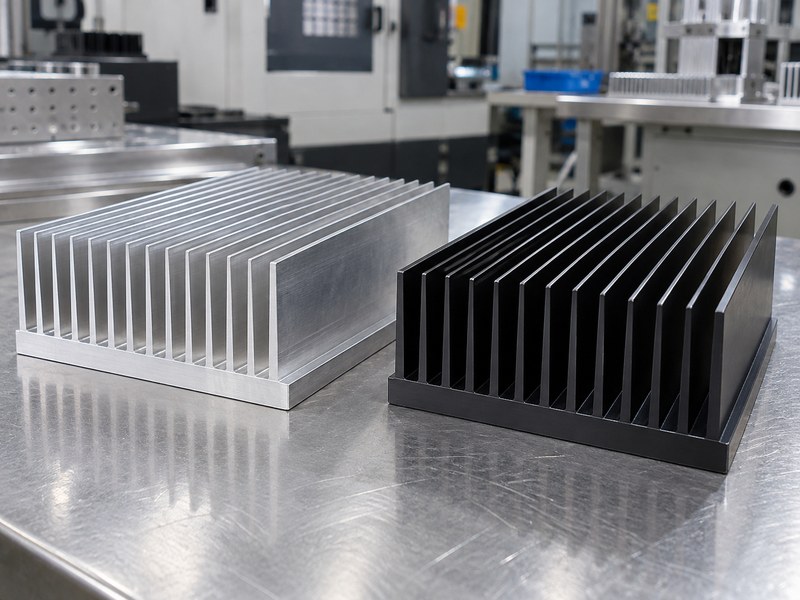
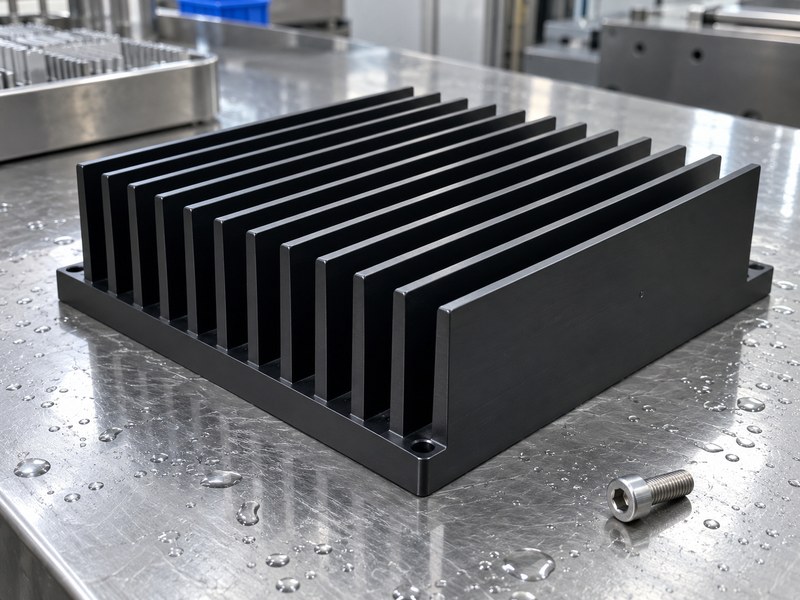
*These illustrative finish samples do not establish matched geometry, material, process or cooling performance.*
2. When does anodizing improve heat rejection?
An anodized heat sink can reject more heat through radiation when its surface has higher thermal emissivity and exchanges radiation with cooler surroundings. Its total temperature change still depends on convection, geometry, mounting, and enclosure temperature. Radiation follows an absolute-temperature relationship; a finish alone cannot justify a fixed cooling percentage across different assemblies.
How do radiation and airflow interact?
Consider where heat travels after reaching the fins. Moving air carries energy away through convection, while exposed surfaces exchange thermal radiation with nearby objects. Faster airflow can make convection dominate the total heat balance, reducing the relative benefit of a finish change even when emissivity increases.
- Compare finishes at the same electrical heat input.
- Hold air temperature and flow conditions constant.
- Record nearby wall temperatures and surface condition.
Can every fin radiate freely?
Closely spaced fins exchange radiation with each other as well as their surroundings. Treating every part of the fin area as an unobstructed radiator overstates heat rejection. A thermal model should represent these geometric relationships rather than multiplying total area by a single unrestricted radiation assumption.
| Condition | Radiation question |
|---|---|
| Open passive assembly | What cooler surfaces can the sink see? |
| Narrow fin channels | How much exchange occurs between fins? |
| Strong forced airflow | How large is radiation’s relative contribution? |
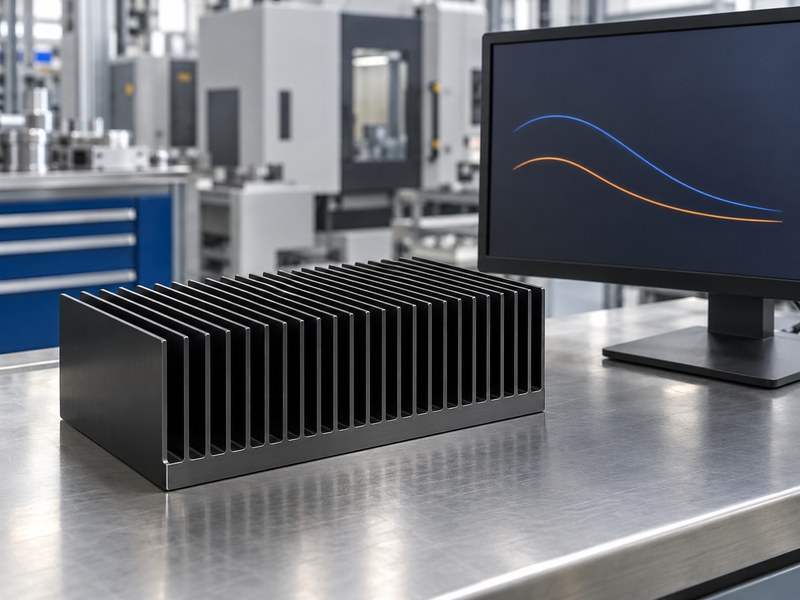
Use the complete heat balance when comparing finishes. The conceptual plot below illustrates qualitative relationships rather than measured performance or a product prediction.
3. Can an anodized heat sink raise contact resistance?
An anodized heat sink can raise contact resistance when oxide covers a surface through which heat must conduct from the device. Aluminum oxide conducts heat differently from the aluminum substrate, and the interface also contains microscopic gaps and an interface material. Whether that surface should remain coated depends on the assembly’s thermal, electrical, environmental, and mechanical requirements.
Where does the interface lose temperature margin?
Inspect the entire stack from device case to heat sink base. Flatness, surface texture, clamp loading, and interface-material thickness can change the temperature drop across that stack. A finish comparison means little if each sample uses a different mounting pressure or interface thickness.
- Identify every surface in the conduction path.
- Control clamp load and mounting sequence.
- Repeat assembly when testing interface sensitivity.
When should you mask the contact pad?
Masking can preserve a metallic contact surface, but the exposed region needs its own corrosion and handling plan. Define its boundary outside the active contact patch where practical. Where electrical isolation requires a dielectric layer, use a deliberately qualified interface system and include its thermal resistance in the design budget.
| Interface need | Engineering response |
|---|---|
| Direct thermal conduction | Evaluate a masked contact pad |
| Electrical isolation | Qualify the complete dielectric stack |
| Repeated assembly | Check wear and interface repeatability |
Test the chosen surface together with its mounting hardware.
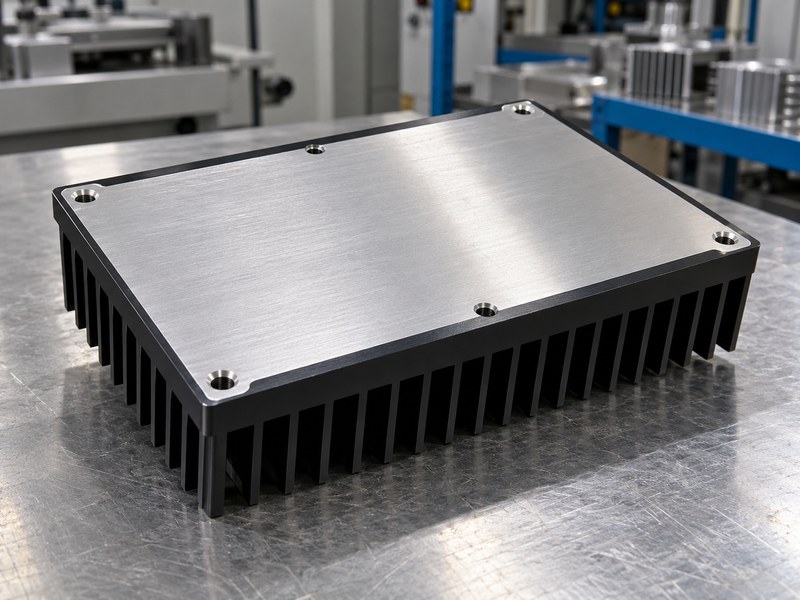
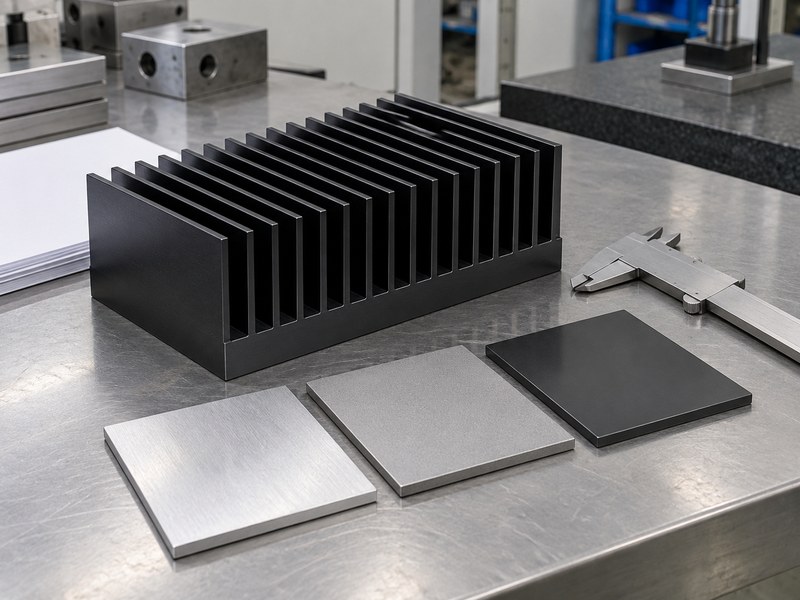
*The bare face illustrates a masking or machining layout; alloy, dimensions, flatness and processing require separate records.*
4. Does black color guarantee better cooling?
Black color does not guarantee that an anodized heat sink will cool better than a clear finish. Visible appearance and infrared emissivity describe different spectral behavior. Two anodized surfaces can look different yet have similar thermal behavior, while differences in process, thickness, surface preparation, or exposure can change their properties.
What should replace a color assumption?
Specify appearance for appearance and thermal properties for thermal analysis. If the design depends strongly on radiation, obtain suitable emissivity information for the actual finish or measure representative specimens. A black sample photograph cannot establish the property needed by a radiation model.
- Keep color acceptance separate from thermal acceptance.
- Use representative finish specimens during development.
- Identify whether direct sunlight reaches the assembly.
What changes in outdoor equipment?
An outdoor surface may absorb solar energy while rejecting heat through infrared radiation. These are separate terms in the heat balance. A finish that works well inside a cabinet may behave differently when sunlight, sky exposure, dirt, and nearby warm structures change its surroundings.
| Selection question | Evidence to request |
|---|---|
| Does the color match? | Approved appearance range |
| Does radiation meet the model? | Relevant emissivity information |
| Will sunlight add heat? | Solar exposure and absorptivity review |
Choose color after defining the thermal environment.
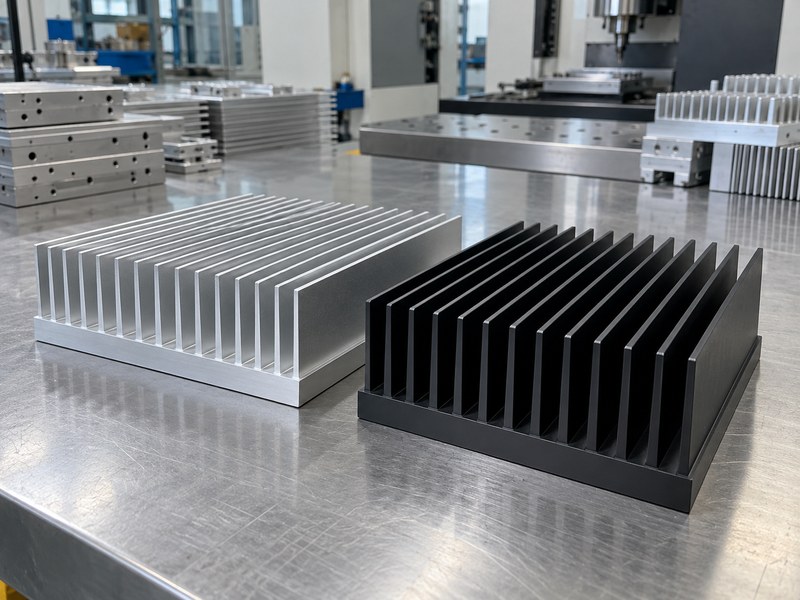
*Surface color alone does not establish infrared emissivity or cooling performance.*
5. How does anodizing protect against corrosion?
An anodized heat sink resists corrosion through its oxide barrier, with sealing and surface continuity affecting that protection. Moisture, salts, scratches, joints, and exposed metal still deserve attention. The finish belongs in an environmental design that includes drainage, adjacent materials, maintenance, and realistic exposure rather than acting as a substitute for those decisions.
Where can damage start?
Inspect cut edges, threaded connections, clamped areas, and places where water can remain trapped. Handling damage may expose substrate after finishing. Contact with a dissimilar metal can create a galvanic concern when an electrolyte bridges the materials, especially where fasteners interrupt the coating.
- Remove water traps near the fin base.
- Review dissimilar-metal joints and fastening details.
- Protect finished parts during transport and assembly.
How should you judge environmental suitability?
Choose tests around the actual failure mechanism: corrosion at a joint, staining on visible surfaces, or deterioration after repeated wetting. An accelerated exposure result helps compare samples under stated conditions. It does not translate directly into a universal service-life promise for every climate or enclosure.
| Exposure | Detail requiring review |
|---|---|
| Condensation | Drainage and trapped moisture |
| Salt contamination | Joints, damage, and exposed substrate |
| Outdoor handling | Scratches and cleaning method |
Examine functional surfaces after exposure, including masked areas.
6. Which anodized finish should you specify?
You should specify an anodized heat sink finish around required corrosion protection, wear behavior, dimensional control, appearance, and electrical interfaces. A thicker or harder coating does not automatically produce a better thermal assembly. Select a recognized process specification with the finishing team, then identify the attributes and acceptance checks your application needs.
How do conventional and hard finishes differ?
Conventional decorative or protective anodizing and hard anodizing target different combinations of appearance, thickness, and wear behavior. Their exact properties depend on process conditions and substrate. Heat sink fins usually require environmental and thermal consideration before anyone adds a wear-focused finish by default.
- State the process and required coating range.
- Define seal and color acceptance where applicable.
- Identify surfaces requiring separate treatment.
Which details prevent ambiguous acceptance?
Describe coating measurements on accessible, representative locations. Deep fin channels may make inspection more difficult than checking a flat coupon. Agree how coupons relate to the part, which marks are permissible, and whether dimensions apply before or after finishing; otherwise two compliant inspections can answer different questions.
| Requirement | Useful acceptance detail |
|---|---|
| Coating thickness | Measurement locations and method |
| Appearance | Reference sample and viewing conditions |
| Functional fit | Finished dimension and surface boundary |
Tie each requirement to a check that can be performed.
7. How do alloy and geometry affect the finish?
Alloy composition, surface condition, and geometry affect how consistently an anodized heat sink can be processed and inspected. Different aluminum materials may produce different appearance even under similar finishing instructions. Dense fins, deep recesses, sharp features, and rack placement can also complicate cleaning, rinsing, coverage, and measurement.
What changes between manufacturing routes?
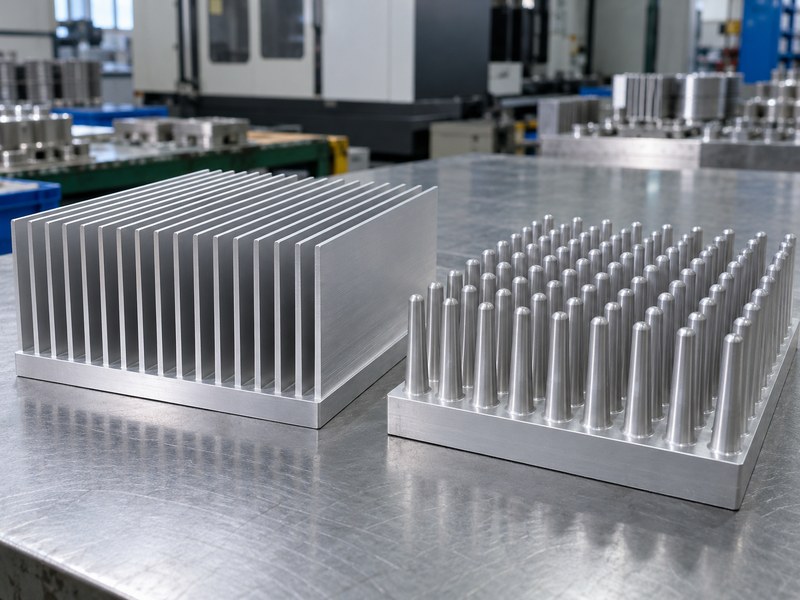
An extruded profile, a machined base, and a forged pin array begin with different geometry and surface histories. Cosmetic uniformity across those parts should be demonstrated with representative samples. A flat color coupon may fail to reveal retained solution, rack marks, or appearance variation on a deep finned component.
- Qualify the intended alloy and manufacturing route.
- Use a complete part for appearance approval.
- Include recessed surfaces in the inspection plan.
Should machining happen after anodizing?
Machining after treatment can expose bare aluminum and remove protection from functional edges. When that sequence serves a purpose, identify the affected surfaces and their acceptance condition. When machining precedes treatment, protect tight fits and contact areas through masking or another agreed process rather than leaving the sequence implicit.
| Part feature | Process question |
|---|---|
| Dense pin array | Can residues drain and rinse away? |
| Precision bore | What is its finished size? |
| Machined contact face | When is protection removed or masked? |
Review the manufacturing sequence alongside the finish drawing.
8. Can anodizing provide electrical insulation?
Anodizing can increase surface electrical resistance, but an anodized heat sink should not be assumed to provide a complete safety insulation system. Film defects, edges, mechanical damage, fasteners, humidity, and operating voltage affect the assembly. Treat protective insulation and intentional electrical bonding as separate engineering requirements with their own verification.
What happens at fasteners and edges?
A screw can damage oxide during assembly, while a sharp edge or scratch may behave differently from an undamaged flat surface. If electrical separation protects a person or a circuit, qualify the entire path under relevant conditions. A coating description alone cannot establish the assembly’s dielectric performance.
- Identify surfaces requiring protective insulation.
- Mark intentional bonding or grounding points.
- Include assembly damage in qualification reviews.
How should a grounded heat sink be designed?
A grounding connection needs a controlled conductive path through the joint. Define surface preparation, hardware, and assembly conditions instead of relying on incidental contact through oxide. Thermal interface material can also alter electrical behavior, so document whether each interface must conduct electricity, block it, or remain outside either function.
| Electrical function | Verification focus |
|---|---|
| Protective insulation | Complete dielectric system |
| Intentional grounding | Controlled conductive joint |
| Nearby energized feature | Clearance and surface condition |
Check the finished assembly after its actual fastening sequence.
9. How should you test the finished thermal assembly?
You should test an anodized heat sink with controlled power, airflow, mounting, and surrounding temperatures, then compare results against your thermal requirement. A bare-versus-coated comparison can isolate a finish effect only when other conditions remain comparable. Record the base temperature and device temperature separately so an interface problem does not disappear inside a single reading.
Which measurements need extra care?
An infrared camera uses surface emissivity when converting radiation into a temperature estimate. Comparing shiny aluminum with anodized aluminum under one unverified camera setting can produce misleading results. Use suitable emissivity settings, a qualified reference method, or contact sensors arranged to limit disturbance of the heat path.
- Measure heat input rather than assuming nameplate power.
- Record inlet air and relevant enclosure temperatures.
- Document sensor location and attachment method.
What belongs in a useful comparison?
Repeat mounting when interface variability could hide a small finish effect. Include uncertainty and distinguish steady operation from warm-up behavior. If a finish difference falls within test scatter, report that limit; selecting a finish for corrosion protection can still be justified without claiming an unproven temperature reduction.
| Test variable | Control or record |
|---|---|
| Heat input | Actual dissipated power |
| Contact interface | Material, thickness, and clamp condition |
| Temperature reading | Location, method, and uncertainty |
Compare results only after checking those controls.
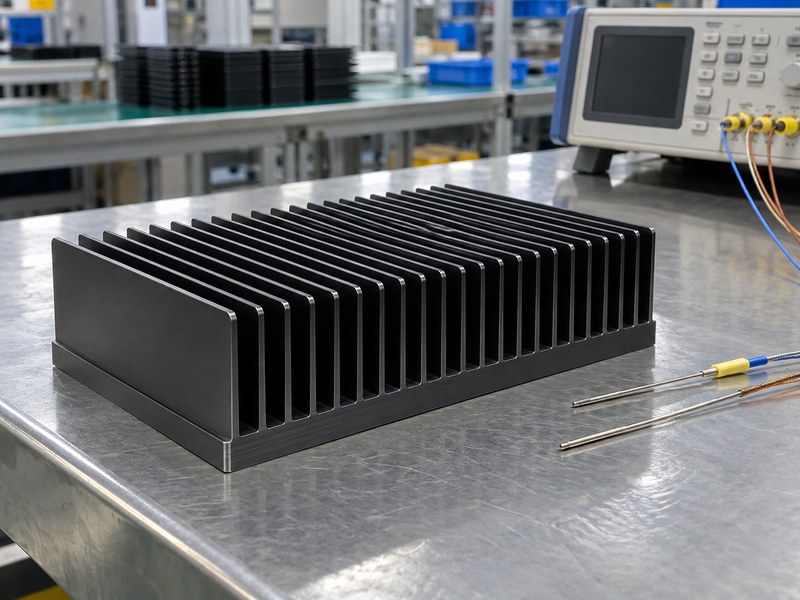
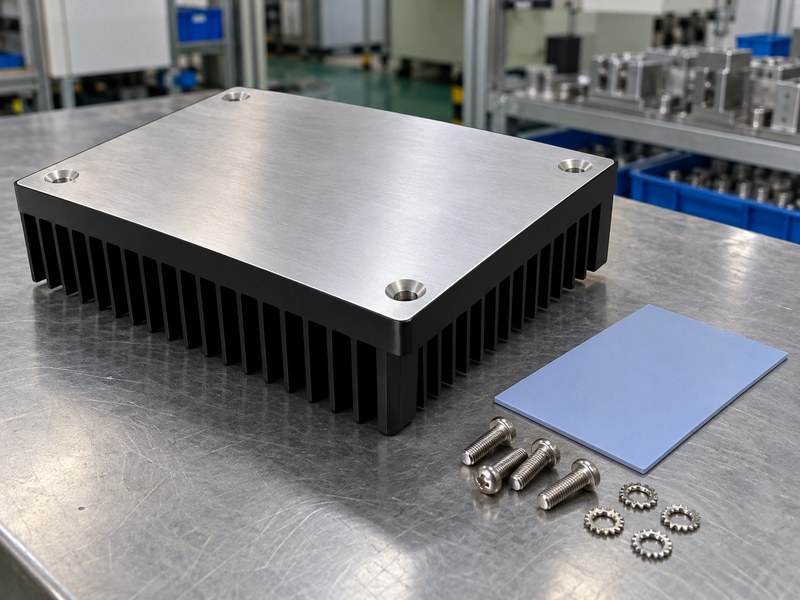
*The probes are not attached to the heat sink; this is test preparation without an operating test or measured result.*
10. What should you settle before releasing the design?
You can release an anodized heat sink design when its surface map, environmental requirements, electrical interfaces, and thermal evidence agree. Keep those records with the drawing so later revisions preserve the reasoning behind the selected finish. An approved appearance sample should accompany the functional requirements whenever visible consistency affects acceptance.
What should the release package contain?
Connect each finish zone with a purpose and an inspection method. Include the relevant thermal test conditions, electrical interfaces, environmental exposure, and permitted handling marks. If a later revision changes the contact pad or masking boundary, the engineer reviewing it can identify which previous evidence still applies.
How do you close the remaining decisions?
Assign unresolved questions to the relevant thermal, mechanical, electrical, or finishing reviewer. To discuss your next assembly, contact us with its heat load, envelope, airflow, mounting drawing, and finish map. Include available test results so the discussion starts from the assembly’s demonstrated behavior.
- Attach the finish map to the released drawing.
- Keep representative inspection and thermal records.
- Review interface changes before approving substitutions.
| Release question | Supporting record |
|---|---|
| Will it meet temperature? | Assembly thermal test |
| Will the finish suit exposure? | Environmental acceptance plan |
| Can production inspect it? | Surface map and inspection method |
Resolve any open item before approving the finished assembly.
FAQ
Q1: Can I anodize the whole heat sink?
Yes, if every coated interface meets its thermal, electrical, and dimensional requirements. Mask selected surfaces when the assembly needs a metallic contact pad, a conductive grounding point, or a tightly controlled fit.
Q2: What’s the best color for a passive design?
Choose from verified surface properties and appearance needs. A dark color alone cannot establish infrared emissivity, and direct sunlight adds an absorption question that an indoor finish comparison may omit.
Q3: How do I know if the contact pad needs masking?
Compare the proposed interface stack against its temperature budget. Evaluate coating, interface material, flatness, and clamp load together, then include corrosion protection for any exposed aluminum in the drawing review.
Q4: Can I treat the oxide as safety insulation?
Only after qualifying the complete insulation system for the application. Include damage, fasteners, edges, and environmental conditions; confirm intentional grounding separately wherever the assembly requires a conductive connection.
Q5: What should I send for a technical review?
Send the heat load, envelope, airflow, environment, mounting drawing, and finish map. Include the current drawing revision and available test results so the review can address the interfaces that determine assembly performance.