
An anodized water cooled heat sink for streetlights merits review when a passive design cannot meet your thermal and packaging requirements. If your compact luminaire overheats during a hot, still evening, a liquid loop may look like an easy escape from larger fins. It also adds hoses, a pump and another heat exchanger above a road. Check the complete thermal path and maintenance burden before choosing that route.
1. Is an anodized water cooled heat sink for streetlights needed?
Consider liquid cooling when a reviewed passive design cannot meet your thermal and packaging requirements. An anodized water cooled heat sink for streetlights belongs in a feasibility review rather than a standard streetlight specification. Most conventional roadway luminaires reject heat through their housing and exposed fins. A crowded LED layout, restricted enclosure or unusually concentrated load may justify studying a remote liquid circuit.
Which passive changes should you test first?
Compare a larger contact area, better heat spreading, wider fin passages and a lower drive current before accepting a pumped loop. Examine extruded heat sinks against your mounting orientation and available space. Include accumulated dirt and low wind in that comparison; a pleasant breeze during a demonstration can hide an undersized passive design. Liquid cooling earns its added parts only when its system benefit survives this comparison.
- Record the passive design that failed your requirements.
- Identify which dimensional constraint prevents a larger housing.
- Compare electrical derating with added cooling equipment.
| Design condition | Direction for review |
|---|---|
| Available fin area meets limits | Retain passive cooling |
| Local spreading limits performance | Review base and interface |
| Heat must travel beyond the luminaire | Evaluate remote cooling |
Price both architectures against the same operating conditions.
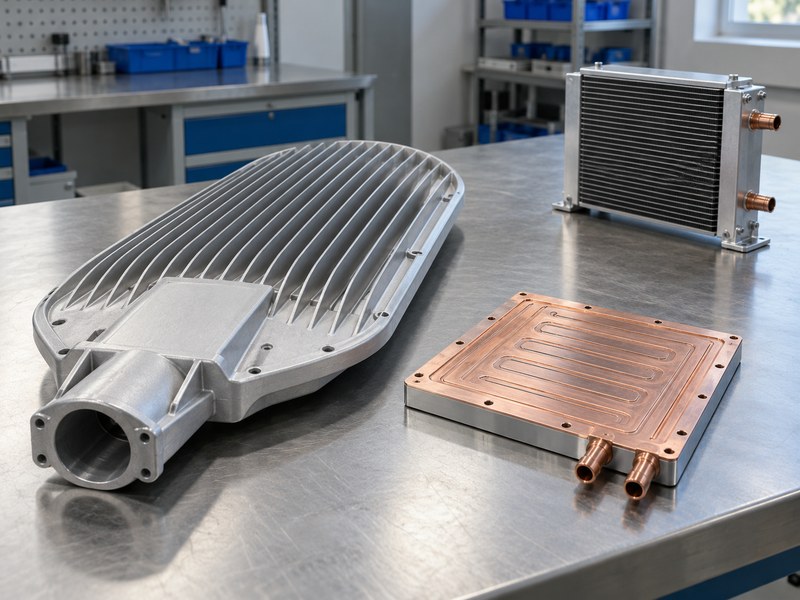
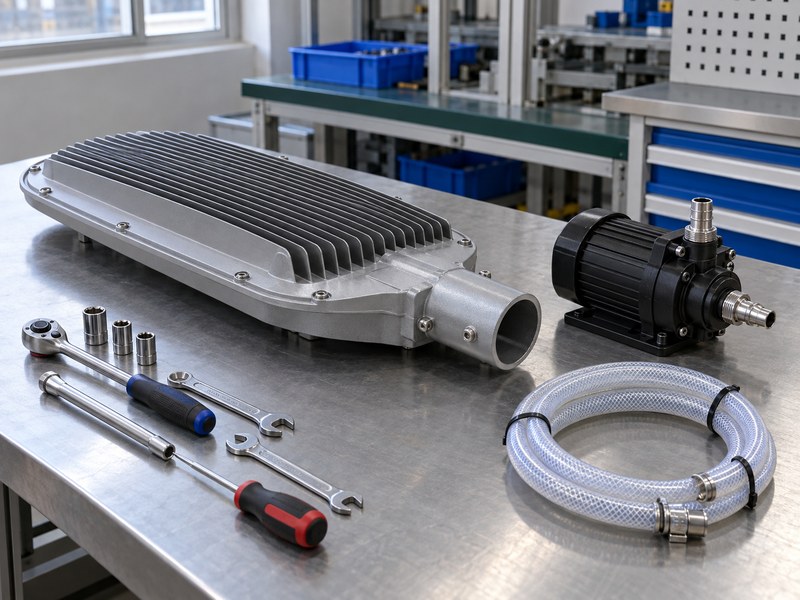
*Separate illustrative components, including an open-channel manufacturing sample awaiting a cover and sealing.*
2. How should you calculate the streetlight heat load?
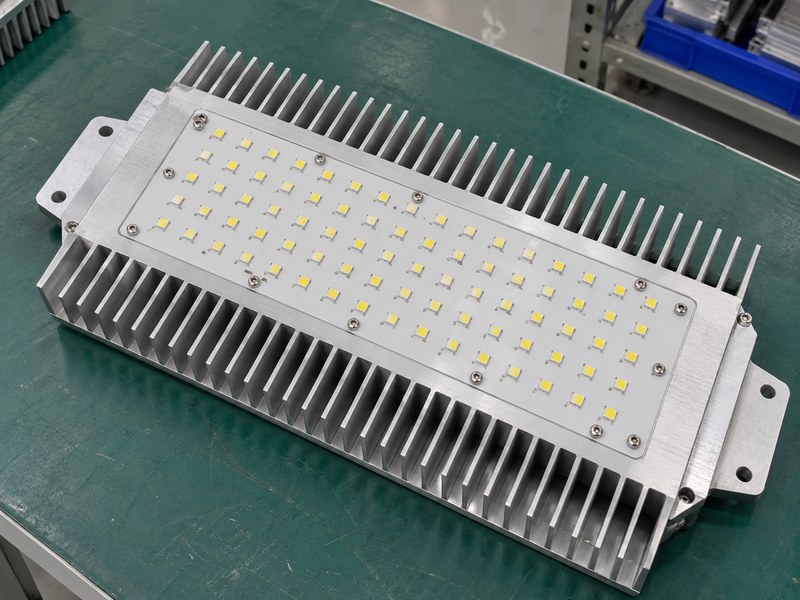
Calculate dissipated heat from the actual electrical and optical operating point, then allocate allowable temperature rise across every interface. An anodized water cooled heat sink for streetlights cannot correct an inaccurate heat budget. LED input power and emitted optical power are different quantities. Keep driver losses separate unless your proposed cold plate also receives that heat through a defined mounting path.
Where does the temperature allowance go?
Work backward from the selected LED operating temperature, using its documented junction-to-reference resistance and your measured mounting conditions. Reserve allowances for board conduction, interface material, plate spreading and coolant temperature. Include uncertainty from installation and sensor placement rather than spending the entire allowance on a nominal simulation. The design target should support your lifetime and light-output requirements; an absolute maximum rating provides a boundary for damage, not a routine operating goal.
- State LED current and dimming conditions.
- Identify where driver heat enters the assembly.
- Record ambient air and coolant inlet limits separately.
| Heat-path element | Input your model needs |
|---|---|
| LED package | Supplier thermal reference and resistance |
| Board and interface | Geometry, materials and contact conditions |
| Cold plate and loop | Fluid temperature and thermal performance |
Check calculated junction temperature against a representative assembled luminaire.
3. Where does the circulating water release its heat?
The circulating fluid releases heat through a separate heat exchanger sized for the local environment. An anodized water cooled heat sink for streetlights moves heat away from the LED board; a closed loop still needs a route into ambient air or another permitted sink. Include radiator airflow, pump heat, fouling and installation space in your layout. A concealed radiator inside a hot pole cabinet can erase the advantage of a cold plate.
What does a flow calculation tell you?
For an illustrative 100 W load and a 5 K water temperature rise, the fluid energy balance gives approximately 0.29 L/min. That calculation assumes water properties near room temperature and represents transported heat only. It does not establish cold-plate resistance, radiator capacity or pump selection. Glycol concentration and cold weather change fluid properties, so obtain the actual mixture data before calculating your operating point.
- Draw the return path as well as the supply path.
- Locate fill, vent and expansion provisions.
- Check radiator airflow with its installed guards.
| Component | Design responsibility |
|---|---|
| Cold plate | Collect heat from the mounting face |
| Pump | Overcome loop pressure losses |
| Heat exchanger | Release transported heat into its surroundings |
Select flow from coupled thermal and hydraulic checks.
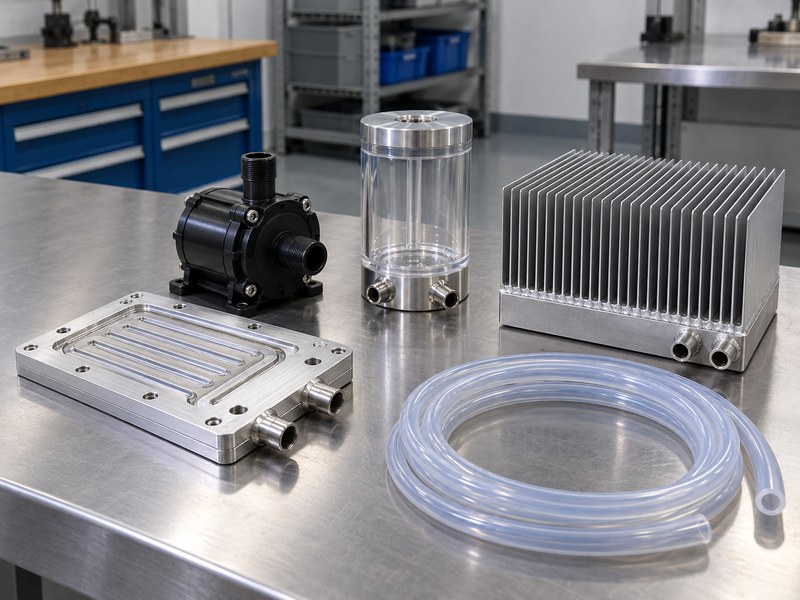
*The open-channel sample awaits a cover and sealing; the proposed loop components are laid out separately.*
4. Which surfaces should receive the anodized finish?
Specify external finishing and coolant-side protection as separate requirements. An anodized water cooled heat sink for streetlights may have a protective exterior while its internal channels require a different material and corrosion strategy. A black exterior does not prove that hidden passages received uniform treatment. Channel geometry, joining method, trapped chemistry and post-process cleaning all affect what a manufacturer can deliver inside a sealed plate.
How should you define the wetted boundary?
List every wetted material, including fittings, pump components, seals and any radiator. Review friction stir welded cold plates by their channel construction and inspection access before assigning a finish. Ask whether machining or joining occurs before or after exterior anodizing. Keep cosmetic acceptance separate from coolant compatibility, since a visually consistent housing gives you little evidence about internal cleanliness or corrosion behavior.
- Mark exterior anodizing on the drawing.
- Identify masked contact faces and port features.
- Require a compatible coolant and cleaning plan.
| Surface or feature | Requirement to define |
|---|---|
| Exposed housing | Finish, sealing and appearance |
| Coolant passage | Material compatibility and cleanliness |
| Port and seal land | Finished dimensions and sealing condition |
Approve the internal protection strategy before approving a cosmetic sample.
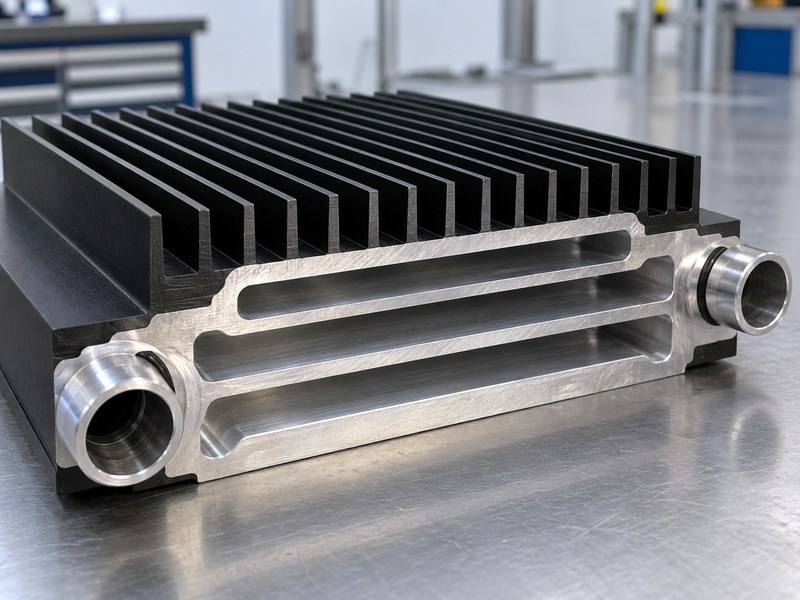
*Sectioned sample showing passage walls and port features; the full manifold route and seal details are outside this view.*
5. How do freezing conditions change the loop design?
Freezing conditions require a coolant formulation and mechanical layout that tolerate storage, shutdown and cold starts. An anodized water cooled heat sink for streetlights must survive weather even when the LEDs are off. Specify minimum exposure temperature separately from normal nighttime operation. Selecting a fluid for burst protection alone can leave a mixture too slushy or viscous for the required restart flow.
Which cold-start checks should you request?
Use the fluid supplier’s concentration, compatibility and temperature data instead of choosing a glycol percentage by habit. Confirm pump capability at the coldest required startup condition and include hose, radiator and channel losses. Provide expansion capacity and identify pockets that cannot drain. Treat fluid concentration as a maintained condition: repeated water top-ups can change freeze protection and inhibitor levels without changing the appearance of the liquid.
- Define freeze protection and restart requirements separately.
- Check seals and hoses across the temperature range.
- Specify how technicians verify fluid concentration.
| Weather condition | Check before release |
|---|---|
| Cold storage | Fluid and component survival |
| Cold startup | Pump operating point and flow |
| Warm operation | Expansion space and pressure |
Match the coolant specification to the installation climate and service method.
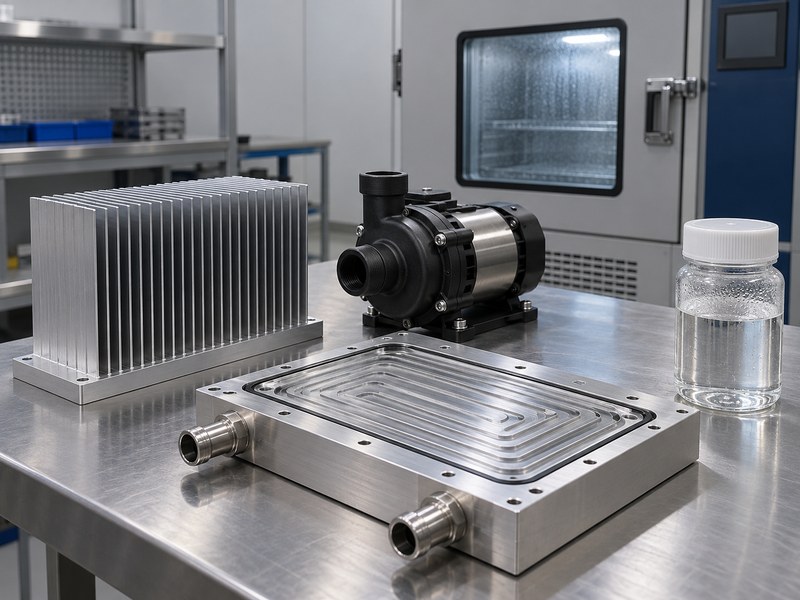
*An open-channel sample and unlabeled coolant bottle; the liquid appearance does not establish its formulation or freeze protection.*
6. Does black anodizing help under direct sunlight?
Black anodizing can aid thermal radiation while increasing absorbed sunlight, so evaluate both effects for an exposed housing. An anodized water cooled heat sink for streetlights operates across different daytime and nighttime conditions. Visible darkness does not supply the longwave emissivity or solar absorptance values your model needs. Request relevant finish data when radiation or solar gain materially changes your temperature allowance.
How should you compare daytime and nighttime behavior?
Model absorbed solar power using projected area, solar exposure and the actual surface absorptance. Evaluate radiation using surface temperature, surrounding temperatures, emissivity and view factors. Closely spaced fins exchange radiation with neighboring fins, so total metal area overstates unobstructed radiating area. Include daytime electronics operation and hot-soak startup if those states occur; an overnight test alone cannot establish solar performance.
- Separate solar absorptance from longwave emissivity.
- Compare sun-facing and shaded surface areas.
- State whether daytime operation belongs in acceptance testing.
| Exposure | Thermal term to review |
|---|---|
| Direct sun | Absorbed solar input |
| Clear night | Radiation toward cooler surroundings |
| Sheltered installation | Restricted air movement and radiation views |
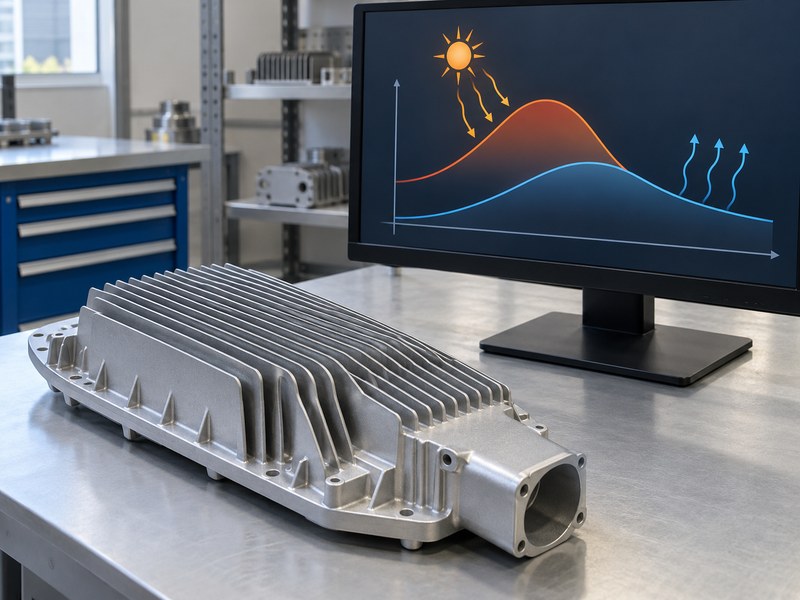
Use finish properties that match your exposure model. The conceptual plot below illustrates competing heat flows rather than measured streetlight or coating performance.
7. Can an anodized water cooled heat sink for streetlights leak?
Yes, joints, ports, hoses and seals create leak paths that an anodized exterior cannot eliminate. An anodized water cooled heat sink for streetlights needs a defined containment and inspection plan. Pressure changes, vibration, thermal cycling and handling can challenge different joints. Place connections away from electrical compartments where possible and evaluate where escaped fluid could travel through cable entries or mounting features.
What evidence should a leak test provide?
Agree on test medium, pressure, duration, temperature and acceptance sensitivity against the assembly’s pressure rating. Separate a pressure-strength check from a test intended to detect small leaks. Record whether testing covers a bare plate, fitted assembly or complete installed loop. Verify sealing after the exposure sequence that represents your application; a new part passing a bench test leaves aging and installation damage unresolved.
- Identify every serviceable and permanent joint.
- Provide hose restraint without loading port connections.
- Keep leak-test records tied to the part revision.
| Potential leak path | Control to review |
|---|---|
| Permanent channel joint | Joining process and inspection |
| Threaded port | Seal design and assembly procedure |
| Flexible connection | Routing, restraint and replacement access |
Set acceptance around the assembled pressure boundary.
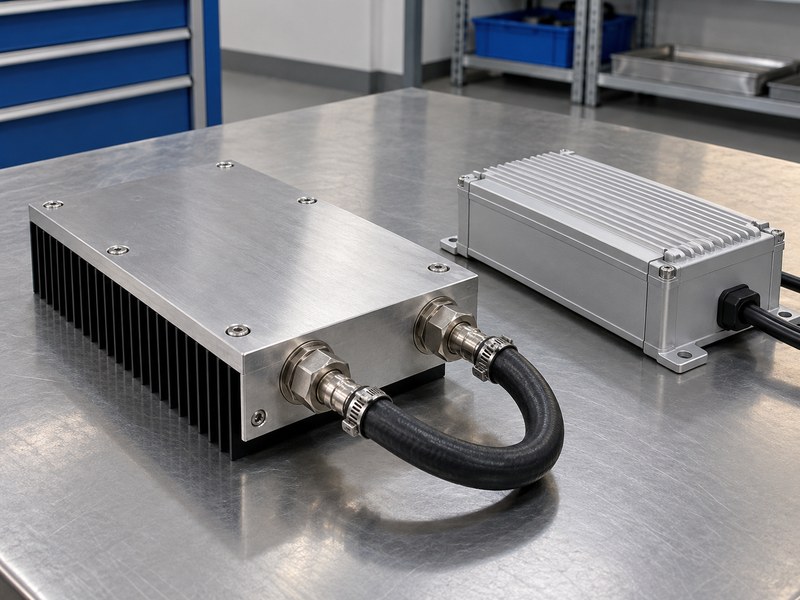
*Temporary U-shaped jumper for a port-connection demonstration; no complete cooling loop is shown.*
8. What happens if the circulation pump stops?
The luminaire must reduce power or shut down before temperatures exceed its defined limits after loss of circulation. An anodized water cooled heat sink for streetlights needs a failure response that works during fouling, air blockage or pump stoppage. Pump power consumption alone does not prove flow. A motor may remain energized while an obstructed circuit transports too little heat.
Which signals should control the response?
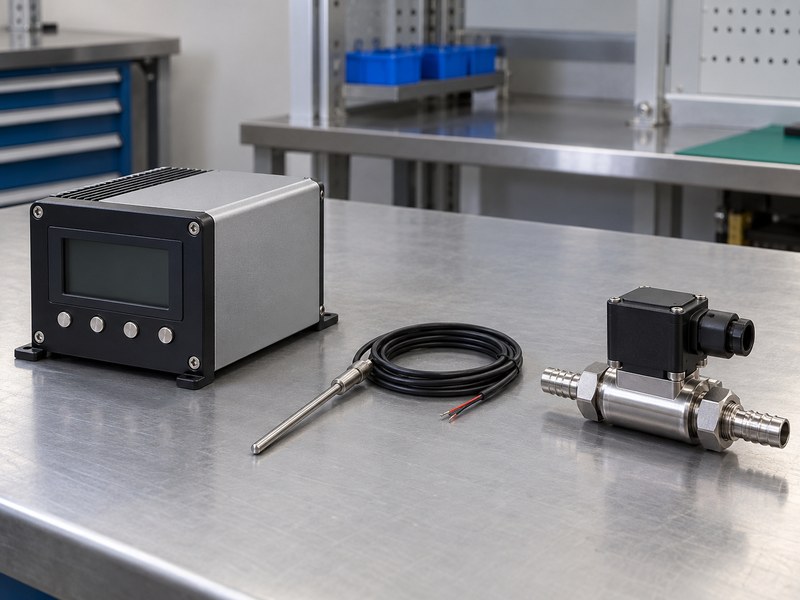
Use temperature sensing close enough to the heat source to detect a developing fault within the available thermal response time. Add flow or pressure monitoring when it provides useful fault coverage. Validate thresholds, sensor tolerances, delay and restart behavior on representative hardware. If a passive fallback path is proposed, establish its allowable LED power and installation conditions rather than assuming exterior fins can carry the original load indefinitely.
- Test blocked flow and disconnected sensing.
- Define reduced-power and shutdown states.
- Limit automatic restarts after repeated overheating.
| Failure condition | Required design decision |
|---|---|
| Pump stops | Safe power level and response time |
| Radiator airflow falls | Temperature detection and derating |
| Sensor signal fails | Defined fault state |
Include fault behavior in the same approval plan as normal operation.
9. How do you compare lifetime service costs?
Compare complete installed and maintained systems over the planned service period. An anodized water cooled heat sink for streetlights adds fluid checks, replaceable components and potential access work to its purchase price. Include pump electricity, service travel, traffic management and spare-part availability. Treat maintenance frequency as a proposal requiring support from component data and exposure testing, rather than assigning a convenient interval during quotation.
Which alternatives deserve a costed comparison?
Compare enlarged passive housings, improved board spreading and lower electrical loading before estimating the value of remote liquid cooling. Heat pipe heat sinks can move concentrated heat without an external circulation pump, but still require orientation, temperature-range and rejection checks. Ask your service team how technicians will drain, refill and vent a pole-mounted circuit. A design that fits on a drawing may still require an impractical roadside repair sequence.
- Estimate labor with the actual access method.
- Price replacement pumps, hoses and prepared coolant.
- Check parts availability over the intended service period.
| Cost category | Include in comparison |
|---|---|
| Installation | Mounts, piping, wiring and commissioning |
| Operation | Pump energy and fault monitoring |
| Service | Access, replacement parts and fluid handling |
Use the same service-life assumptions for every candidate architecture.
10. What should your specification and approval package contain?
Your package should define thermal duty, environmental exposure, fluid boundaries and acceptance evidence before anyone quotes production hardware. An anodized water cooled heat sink for streetlights requires agreement on the whole loop, including who supplies the radiator, controls and service procedure. Separate required performance from a preferred construction method. A supplier can then identify a simpler route or flag a requirement that the proposed package cannot meet.
Which decisions belong in the release record?
Assign responsibility for the cold plate, pump, radiator, controls and commissioning procedure. Record the accepted coolant condition, leak-test method and response to loss of flow. Keep installation and service instructions with the approved drawing so a later replacement does not silently change the pressure boundary or freeze protection.
- Record the required operating states and fault responses.
- Identify who supplies and validates each loop component.
- Keep approved coolant and service instructions with the drawing.
| Package item | Required content |
|---|---|
| Thermal inputs | Heat map, operating states and temperature limits |
| Installation | Envelope, orientation, climate and service access |
| Acceptance plan | Thermal, leak, fault and exposure checks |
Send your LED layout, heat budget and installation constraints when you contact us. Request a comparison of passive and liquid options, with unresolved assumptions listed before tooling approval.
FAQ
Q1: Can I use tap water in the cooling loop?
Use only approved water quality and coolant chemistry. Local tap water varies, and every wetted material needs to be compatible with the specified fluid over the intended operating range.
Q2: Can I keep the existing fins as a pump-failure backup?
Possibly, if testing establishes their allowable reduced-power load. Confirm the installed airflow and ambient conditions, then connect that fallback capacity with the controller’s derating response.
Q3: What’s the best black finish for an outdoor plate?
Choose a finish against stated exposure and thermal requirements. Specify sealing and appearance separately from the surface properties used for radiation and solar calculations.
Q4: How do I know if coolant flow is sufficient?
Verify plate temperature and pressure loss at the required coolant condition and heat load. A flow value alone cannot establish the temperature at the LED mounting surface or the capacity of the remote radiator.
Q5: Can I avoid routine fluid checks with a sealed loop?
Only when the validated system and service plan support that interval. Sealed construction alone cannot establish how coolant condition, seals and component aging will behave in your installation.