
A heat sink for voltage regulator applications can be made from aluminum, copper or a combination of materials. Aluminum often suits an extruded fin profile, while copper can help spread concentrated heat. Identify the specified material from the drawing or supplier record before making a thermal decision; color and finish alone are unreliable evidence.
1. Is a heat sink for voltage regulator cooling aluminum?
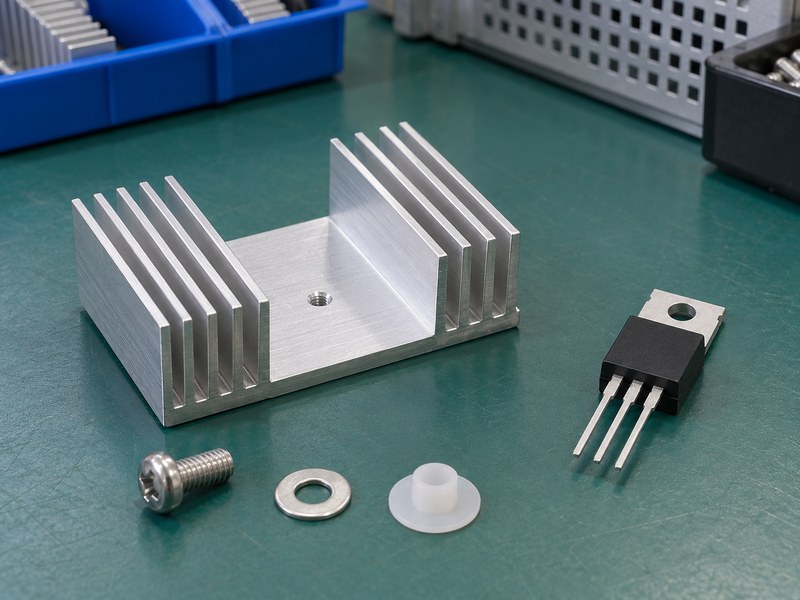
A heat sink for voltage regulator cooling can use aluminum, but material identity cannot be settled from appearance alone. Black anodizing can hide the original metallic color, and plated or coated parts complicate visual identification. Check the part specification before assigning material properties.
Identify the finished construction
The cooling part may be a single extrusion, a machined block, a stamped sheet or an assembly with a separate base and fins. An aluminum profile can also include inserts or other materials at its mounting interfaces. Record the alloy and construction where those details affect thermal spreading, machining or joining.
- Request the material and finish on the drawing.
- Identify separate base, fin and insert materials.
- Keep supplier substitutions subject to the approved specification.
Separate identification from performance
Knowing that a sink is aluminum does not establish its resistance to air. Geometry, interface and installed cooling conditions still determine how the assembly behaves. Review board-level heat sinks against the package and application, rather than treating the material name as a cooling rating.
| Identification evidence | What it establishes |
|---|---|
| Controlled drawing | Intended material and finish |
| Supplier traceability | Material used for the delivered lot |
| Product photograph | Appearance and visible construction only |
Use documented material identity as an input to design, not as proof of thermal performance.
2. Why is aluminum useful for regulator heat sinks?
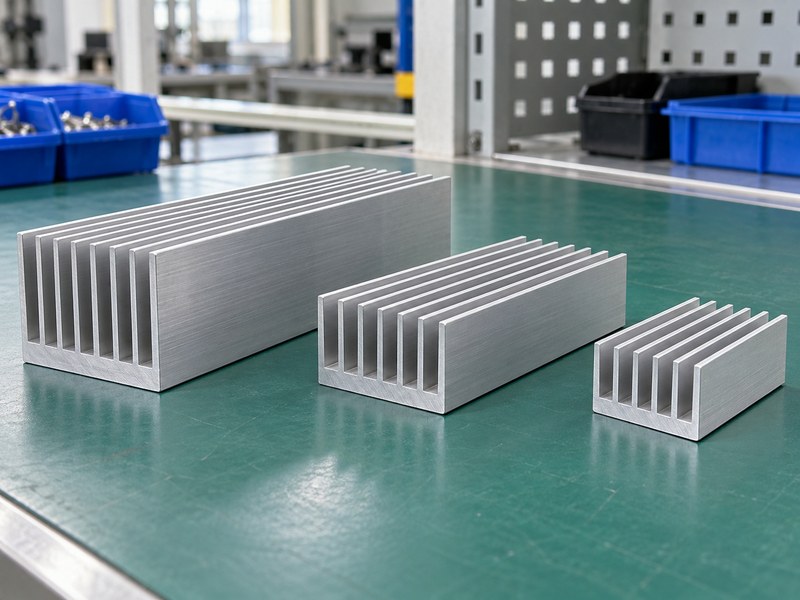
Aluminum is useful for regulator heat sinks because suitable alloys can form practical fin profiles with manageable mass and machinable contact features. The relevant choice is a specific alloy and manufacturing route. Different aluminum grades and tempers do not provide identical thermal or mechanical behavior.
Match the alloy with the process
A profile intended for extrusion has different manufacturing priorities from a machined mounting block or a casting. Ask the supplier which material supports the required fin geometry, contact tolerances and production quantity. Keep the approved alloy explicit when comparing quotations so a change in processing route does not introduce an unreviewed material substitution.
- Specify alloy and temper where the design requires them.
- Review fin and base geometry with the manufacturer.
- Check finished machining and coating requirements.
Compare a complete proposal
An aluminum sink with a suitable contact face and usable airflow can outperform a poorly arranged part made from a more conductive material. Compare the candidate assembly under the same load, air temperature and orientation. The lowest raw-material cost does not necessarily give the lowest cost after machining and acceptance.
| Aluminum design factor | Application question |
|---|---|
| Alloy and temper | Compatible with the selected process? |
| Mass | Acceptable for the board and supports? |
| Contact machining | Meets the package interface requirements? |
Select an aluminum construction that the supplier can produce and validate consistently.
3. When should you consider copper instead?
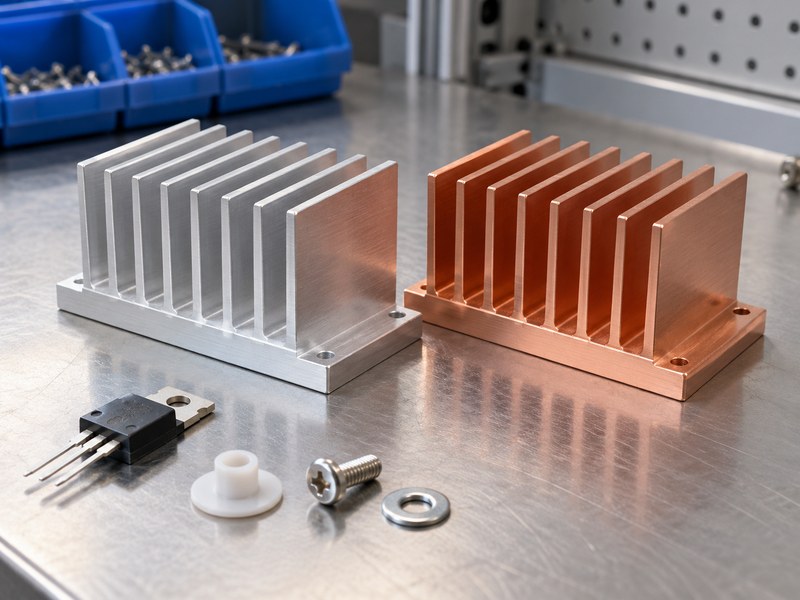
Consider copper when concentrated heat spreading or another application requirement justifies its manufacturing and mass implications. Copper’s higher thermal conductivity can reduce some conduction drops, but the completed sink also has an air-side resistance. Changing material cannot fix an obstructed fin channel or poor package contact.
Identify the resistance you need to reduce
A small regulator tab on a wide, thin base can create a spreading problem near the source. Compare that local drop with the interface and sink-to-air drops before selecting copper. If the air-side path dominates, a geometry or airflow change may provide more benefit than substituting the base material alone.
- Check the size of the heat-source footprint.
- Review the local base-temperature distribution.
- Compare material alternatives in the same installed conditions.
Include mounting and manufacturing effects
A copper design may need different supports, machining operations or finishing requirements from an aluminum extrusion. A CNC machined heat sink can provide custom contact geometry in either material where the process suits the part. Ask for a finished assembly comparison, including interfaces and production inspection.
| Reason to consider copper | Additional review |
|---|---|
| Concentrated source | Base spreading benefit |
| Restricted envelope | Geometry and air-side capacity |
| Different material mass | Support and handling loads |
Choose copper when its contribution improves the relevant thermal path enough to justify the full design change.
4. Can a surface finish reveal the base material?
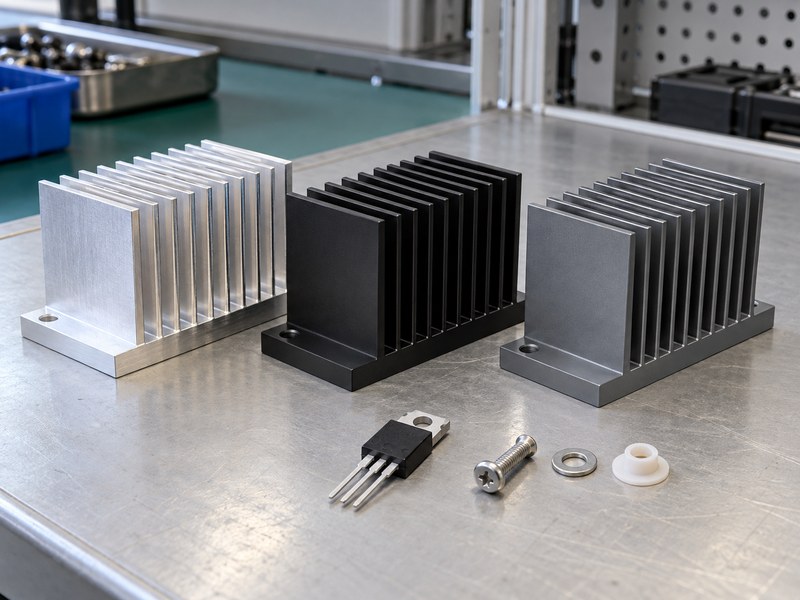
A surface finish can suggest a process, but it does not reliably identify a regulator heat sink’s complete material construction. Black anodized aluminum is familiar, yet other coatings and assembled parts can look similar. Material acceptance should follow the drawing and traceability record.
Inspect the specified finish
Record which surfaces receive coating and which mounting lands or holes need masking or another controlled treatment. A finish can affect dimensions, interface behavior and corrosion performance. Ask the supplier to define how the finished part will be inspected instead of relying on a color sample to cover all those requirements.
- Identify the finish type and relevant surfaces.
- Specify any masked contact or threaded regions.
- Check finished dimensions at the mounting interface.
Keep finish claims separate
Radiation behavior can change with surface finish, but the total cooling effect depends on temperature, surroundings and convection. A black surface does not supply a universal improvement percentage. Compare the proposed finished sink in the intended installation before assigning credit for its appearance.
| Visible feature | What it cannot establish alone |
|---|---|
| Black surface | Material identity or cooling rating |
| Silver surface | Exact alloy or surface treatment |
| Plated appearance | Base and fin construction |
Accept the finish through its specification and the thermal result through its operating conditions.
5. Is anodized aluminum electrically insulating enough?
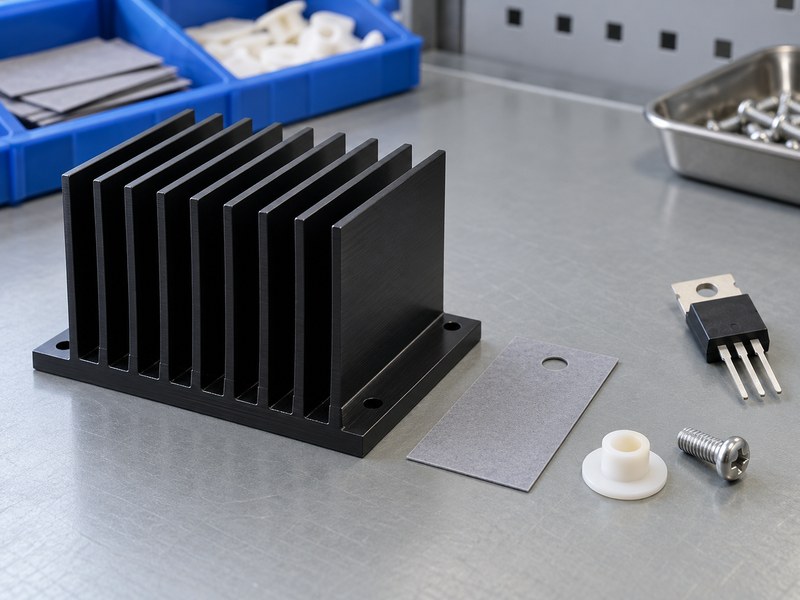
Do not use the anodized surface alone as an assumed isolation system for a voltage regulator tab. Cut edges, holes, defects and assembly wear can expose conductive metal. The required electrical separation needs a specified mounting arrangement and appropriate finished-assembly acceptance.
Check the tab potential
Read the exact regulator’s package information, including its pin and package drawings, and identify whether exposed metal connects with ground, output or another node. A sink shared with a chassis or another device creates additional conductive routes. Similar packages and matching screw holes do not establish compatible electrical connections.
- Trace tab, screw, clip and bracket routes.
- Use the specified pad and fastener insulation where needed.
- Review approved substitute devices for changed tab connections.
Budget for the insulating interface
An electrically suitable pad can add thermal resistance, so include it before choosing fin geometry. Heat sink mounting hardware should provide the required pressure without damaging the pad or package. Test the final stack after tightening and through the product’s relevant environmental conditions.
| Conductive route | Design control |
|---|---|
| Tab to base | Specified insulating interface |
| Screw to tab | Suitable shoulder or insulated fastener |
| Sink to chassis | Deliberate bonding or isolation arrangement |
Treat the underlying aluminum as conductive whenever the mounting design requires electrical separation.
6. How do manufacturing methods change the geometry?
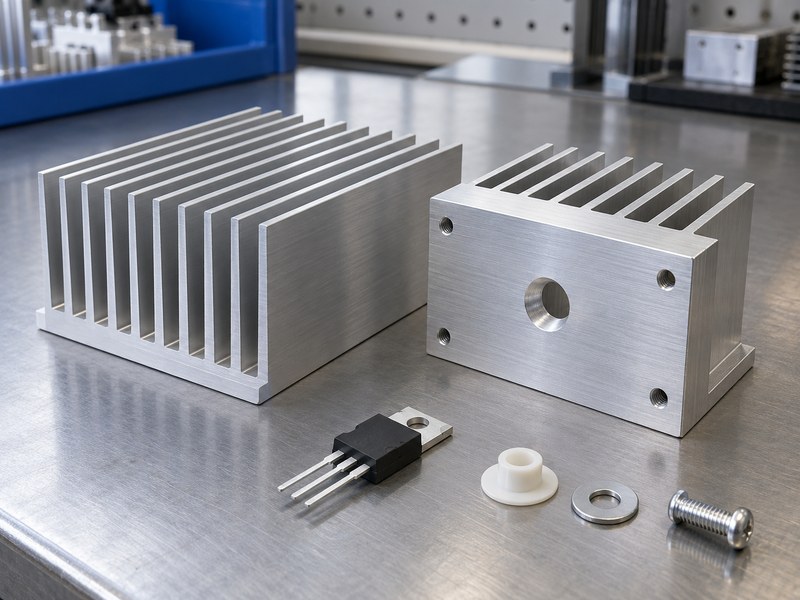
Manufacturing methods change which fin, base and mounting geometries are practical for a regulator heat sink. An extrusion starts from a continuous profile, while machining can add pockets, lands and holes. Stamping, casting and assembled fins follow different tooling and inspection routes.
Start from the required contact and air path
Define the package footprint, mounting face and available envelope before selecting a process. A standard extrusion with limited machining may satisfy a small regulator application. A custom height stack or stepped contact pattern may require more detailed machining, while an unnecessary custom process can add development work without improving the thermal path.
- Identify which dimensions control contact and clearance.
- Keep fin passages usable in the installed airflow.
- Review tooling and repeat-order requirements with the supplier.
Compare finished-state tolerances
The relevant dimensions are those delivered after all machining and finishing operations. Coating, edge treatment and thread processing can affect the mounting fit. For extruded heat sinks, distinguish profile tolerances from the tighter features added by machining.
| Process route | Feature to review |
|---|---|
| Extrusion | Continuous profile and available sections |
| Machining | Contact lands, holes and datums |
| Assembled construction | Fin-to-base joints and inspection |
Choose the process that can reproduce the required contact and cooling geometry.
7. What changes when you combine metals?
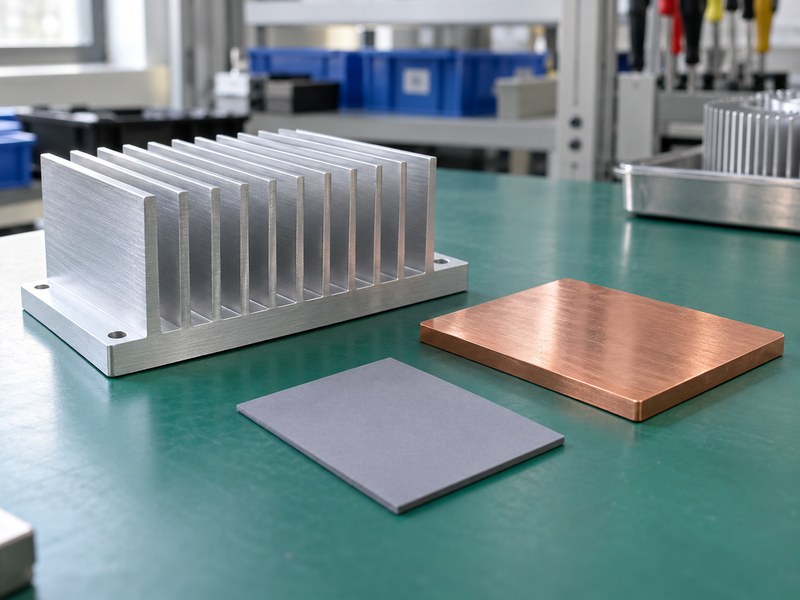
Combining metals can change joint resistance, mechanical behavior and corrosion requirements in a regulator cooling assembly. A copper spreader on an aluminum sink adds another interface unless the design provides a suitable bonded or joined construction. Evaluate that joint instead of adding the materials’ conductivities as if they were one continuous part.
Review the thermal joint
Specify contact area, pressure and any interface material between the metals. A small void or poorly controlled contact can consume the spreading benefit expected from a copper insert. If the construction uses a joined base and fins, ask how the joint quality is controlled and how the complete part is tested.
- Identify every added interface in the heat path.
- Review flatness, support and expansion behavior.
- Test the assembled construction at the intended load.
Review the service environment
Dissimilar-metal contact in a conductive environment can require corrosion controls. Moisture exposure, finish damage and the chosen fasteners influence that review. Define the actual environment and suitable materials or barriers with the supplier rather than assuming that a dry bench result covers all installations.
| Mixed-material issue | Evidence to request |
|---|---|
| Added joint | Controlled thermal contact |
| Mechanical mismatch | Assembly and environmental review |
| Corrosive exposure | Suitable material and finish controls |
Judge the combined construction through its joints and service conditions.
8. How do you compare material alternatives thermally?
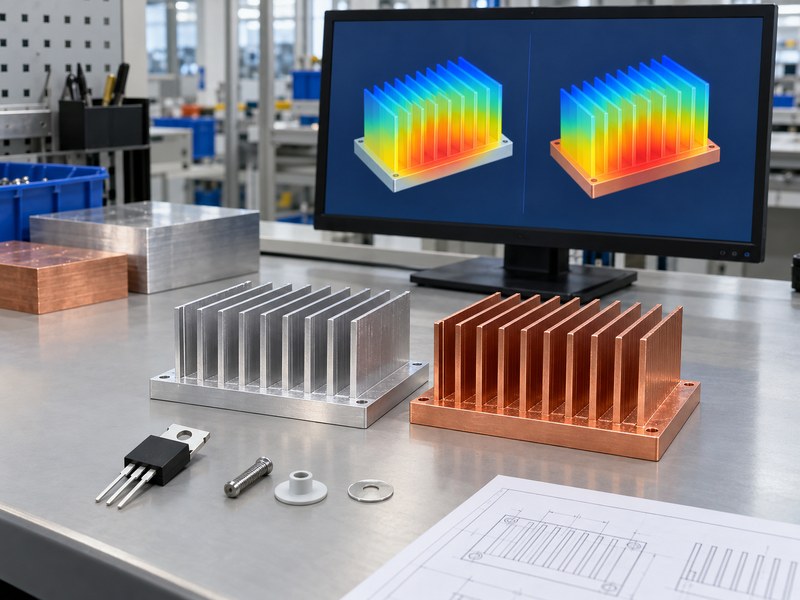
Compare material alternatives using the complete regulator cooling assembly at the same electrical loss and local air conditions. A conductivity comparison explains one material property, while a thermal test captures the contact, spreading and air-side paths together. Keep geometry and mounting differences visible in the comparison.
Define the comparison question
You might compare equal envelopes, equal masses or two supplier proposals that meet the same junction target. Those are different engineering questions and can produce different choices. State which constraint matters to the product before interpreting a temperature difference between an aluminum and copper sample.
- Match the heat-source footprint and interface process.
- Record orientation and local inlet air temperature.
- Identify every geometry change between samples.
Measure with suitable methods
Infrared readings on bare aluminum and copper can be misleading because of surface emissivity and reflections. Use appropriate surface treatment or a contact method, then retain the measurement details. A qualitative heat map can help locate spreading differences but cannot substitute for defined test conditions and measured temperatures.
| Comparison basis | Useful outcome |
|---|---|
| Equal envelope | Performance within the same space |
| Equal mass | Cooling against a weight constraint |
| Same junction target | Finished design and cost comparison |
Use the comparison basis that reflects the actual product constraint.
9. What should an OEM specify for repeat supply?
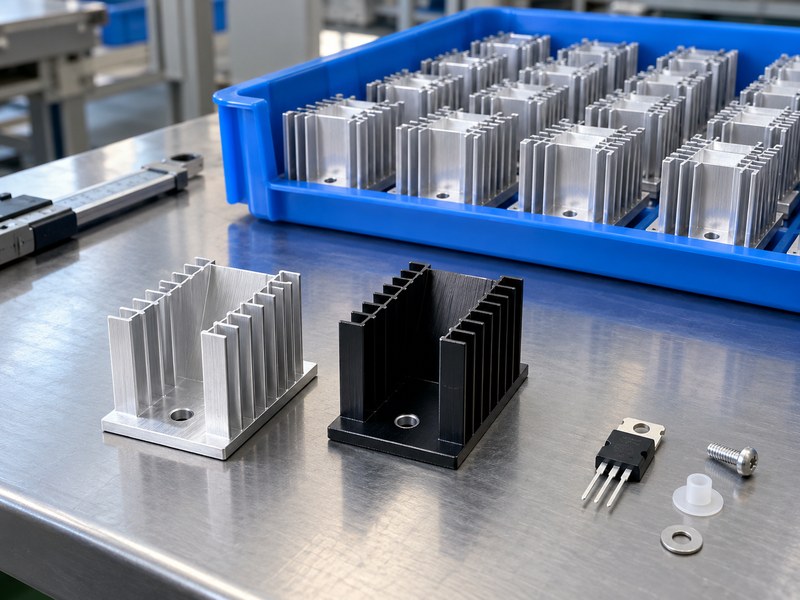
An OEM should specify material, construction, finish and contact requirements for repeat regulator heat sink supply. A description such as “black aluminum heat sink” leaves several manufacturing choices unresolved. Tie the approved sample to a drawing and acceptance record that later orders can reproduce.
Control the material and geometry together
List alloy, temper where relevant, profile or base construction and any approved inserts. Identify contact datums, flatness, hole positions and finish masking. A material substitution that changes machining, strength or thermal behavior needs review even when the delivered part fits the same outer envelope.
- Retain the approved material and finish specification.
- Define acceptance for thermal-contact features.
- Identify changes that require a sample review.
Keep inspection practical
Agree on records and sampling suited to the product and production volume. Visual inspection can catch fin damage or finish defects, while dimensional checks establish mounting fit. Thermal acceptance needs the assembly and operating conditions stated separately from those visual and dimensional checks.
| Specification item | Production purpose |
|---|---|
| Material and finish | Controls the intended construction |
| Contact dimensions | Reproduces the mounting path |
| Acceptance method | Links delivered lots with the approved sample |
Write the requirement so a supplier and inspector can reach the same acceptance decision.
10. How should you choose the final material?
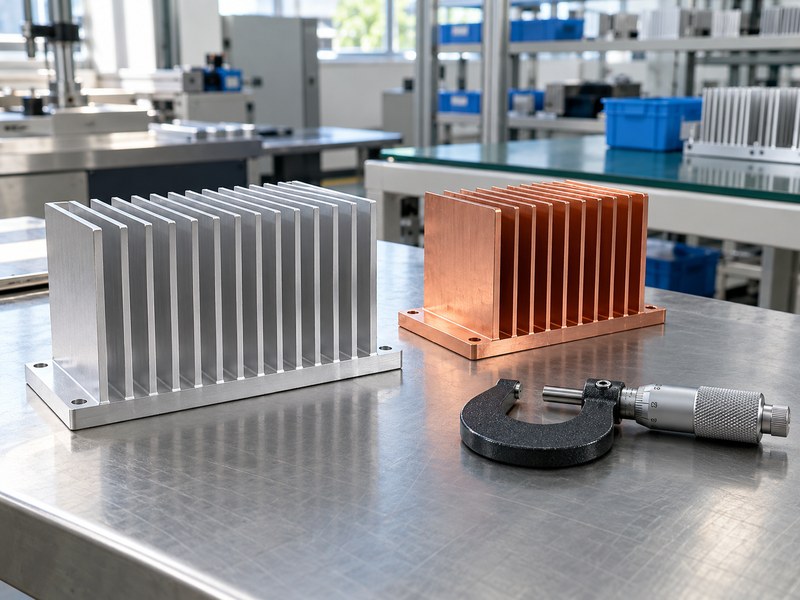
Choose the final regulator heat sink material from the required thermal path, mechanical constraints and validated manufacturing proposal. Aluminum can be suitable for a practical fin profile, while copper or a combined construction may address a specific spreading requirement. Keep the final choice tied to measurable acceptance conditions.
Review the dominant temperature drops
Separate the package, interface, local spreading and air-side contributions before changing material. If the interface dominates, a conductivity improvement elsewhere may provide little benefit. If local spreading limits the design, compare base geometry and material together while preserving a repeatable mounting arrangement.
- Identify the resistance that needs reducing.
- Compare complete proposals under matching conditions.
- Include mass, finish, supports and repeat supply.
Send a material review brief
Bring your package drawing, heat load, local ambient and available envelope when you contact us. We can discuss a suitable aluminum, copper or mixed-material construction against those inputs. Agree on the prototype test and material specification before approving repeat production.
| Final review | Acceptance basis |
|---|---|
| Thermal | Meets the junction target in the assembly |
| Mechanical | Fits and supports the specified package |
| Manufacturing | Reproduces the approved material and geometry |
Keep the material decision with the test evidence and released drawing.
Q1: Can I tell whether a black heat sink is aluminum?
Not reliably from color alone. Check the drawing or supplier material record, including any separate base, fin or insert materials.
Q2: What’s the best material for a small regulator sink?
The suitable material meets the thermal and mechanical requirements in the available envelope. Compare the finished designs rather than conductivity alone.
Q3: How do I know if copper will improve my design?
Identify the dominant thermal drop. Copper may help concentrated spreading, but weak contact or poor airflow can still limit the completed assembly.
Q4: Can anodizing replace an insulating tab pad?
Do not assume it can. Holes, edges and assembly damage can expose metal; use the specified isolation system and finished electrical acceptance method.
Q5: Can I approve a different aluminum alloy without retesting?
Only if existing evidence covers the change. Review thermal, mechanical and manufacturing effects, then define the checks needed for the revised construction.