
Get a consistent finish by qualifying the blast process while protecting the heat sink’s contact surfaces and dimensions. A sample can look excellent yet fail assembly because fins bend or grit remains between them. A sandblasting aluminum heat sink specification should connect appearance with measurable acceptance checks before production starts.
1. What does sandblasting aluminum heat sink finishing change?
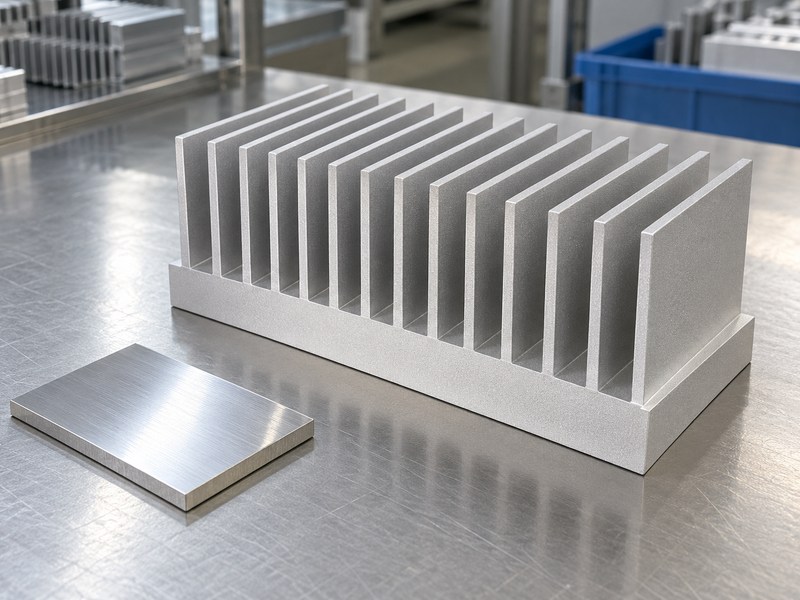
Sandblasting aluminum heat sink finishing changes surface texture and removes selected surface residues; it does not change the underlying alloy’s bulk thermal conductivity. For an extruded part, distinguish visible sidewalls from the base that touches the heat source. A uniform matte surface can meet an appearance requirement while a poorly protected mounting land increases interface resistance. Write separate requirements for those two areas.
What should your drawing identify?
Mark the allowed blast area and give inspectors an approved sample under agreed lighting. Where texture affects fit or coating adhesion, add a measurable surface requirement and a suitable measurement method. A photograph helps explain appearance, but glare, camera exposure and viewing distance can hide differences. Keep that photograph alongside a physical reference rather than treating a screen image as the only acceptance standard.
- Identify cosmetic surfaces and functional lands.
- State the final finishing sequence.
- Record which defects trigger rejection.
| Surface | Requirement to define | Inspection evidence |
|---|---|---|
| Visible sidewall | Approved texture | Reference sample |
| Thermal land | Flatness and finish | Dimensional report |
| Fin channel | No retained debris | Cleanliness inspection |
These requirements let the finishing supplier quote the work without guessing which surfaces can change.
2. How does fin geometry affect sandblasting aluminum heat sink work?
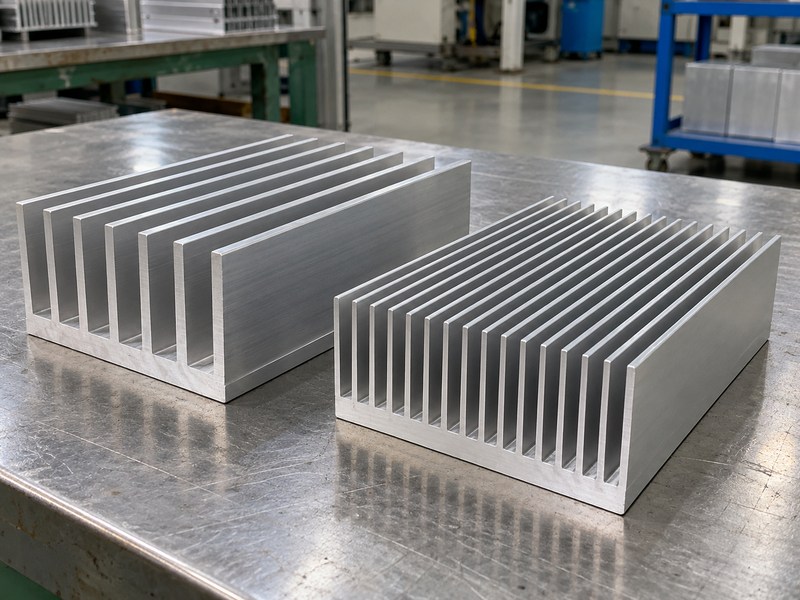
Fin geometry affects sandblasting aluminum heat sink work because thin, tall fins respond differently from a thick base. A process that suits a broad outside wall can damage a slender fin edge or leave a deep channel untreated. Review the actual profile, alloy and temper before selecting a trial setup. Keep the extrusion drawing with the finishing instructions so a later profile revision triggers another review.
Which sample represents production?
Use a part with production geometry for acceptance trials. A flat coupon can help compare texture, but it cannot reveal shadowing between fins, part handling damage or distortion of a long base. Include the longest unsupported section and the narrowest channel in the trial. For example, a short display sample may survive a setup that bends a longer production extrusion after repeated exposure from one side.
- Support the base through a repeatable fixture.
- Keep clamps away from unsupported fins.
- Check both exposed and sheltered surfaces.
| Feature | Trial concern | Verification |
|---|---|---|
| Thin fin | Edge damage | Visual and dimensional check |
| Deep channel | Uneven exposure | Inspection within the channel |
| Long base | Bow after finishing | Drawing-based flatness check |
Approve the process on representative geometry before applying it to a production batch.
3. Which media suit sandblasting aluminum heat sink surfaces?
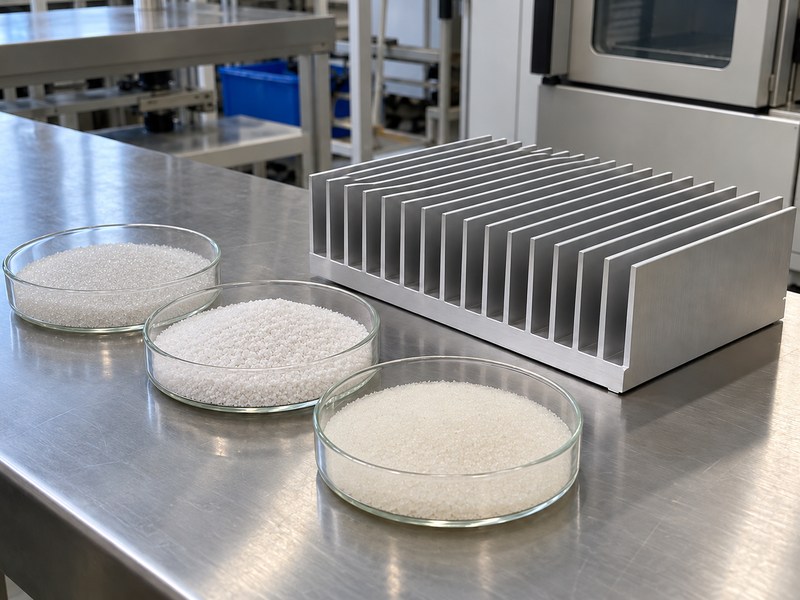
Media for sandblasting aluminum heat sink surfaces should match the required finish, removal allowance and contamination limits. Spherical glass bead and angular aluminum oxide create different surface effects, while plastic media serves other cleaning needs. A custom extrusion may need more than one trial before its appearance and dimensions both pass. Specify the media type and size distribution rather than asking for a generic sandblast finish.
How do you keep the trial repeatable?
Record whether the equipment uses fresh media, reclaimed media or a controlled blend. Media condition changes as particles break down and contamination accumulates. If a supplier handles ferrous parts elsewhere, ask how it separates cabinets, recovery systems and handling tools for your aluminum work. A suitable media name alone cannot establish cleanliness when equipment history remains unknown, especially for an assembly with tight debris limits.
- Qualify the intended production media condition.
- Check access to narrow fin channels.
- Define when media must be renewed.
| Media choice | Candidate purpose | Qualification concern |
|---|---|---|
| Glass bead | Satin appearance | Texture and dimensional change |
| Aluminum oxide | Cutting surface profile | Material removal and residue |
| Plastic media | Selected cleaning tasks | Cleaning effectiveness |
Choose from trial evidence; a harder abrasive does not automatically provide a better finished part.
4. How do you control sandblasting aluminum heat sink exposure?
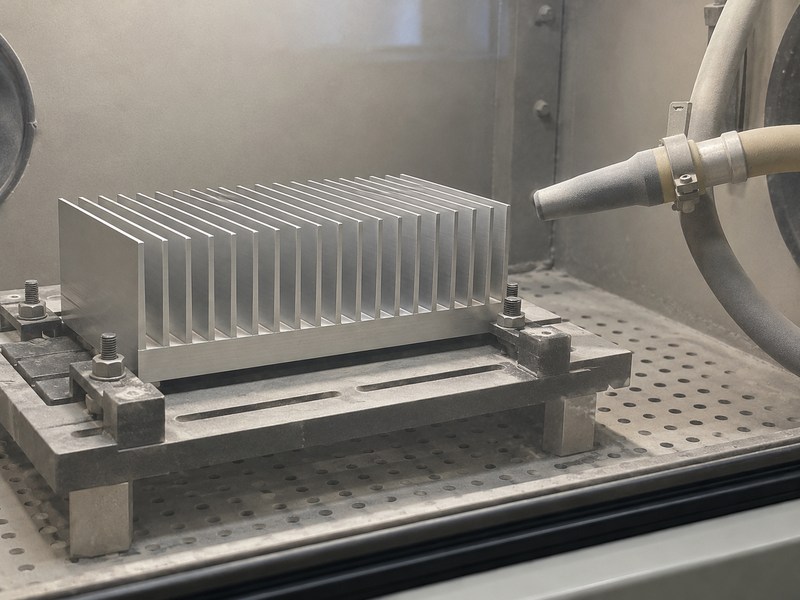
Control sandblasting aluminum heat sink exposure through a documented combination of equipment settings, nozzle position, travel and part support. Pressure alone cannot describe the energy delivered to a fin or base. Nozzle wear, media flow and working distance can change the result even when the regulator stays untouched. Begin with a supplier-qualified trial on representative geometry and adjust one variable at a time.
What belongs in the process record?
Record the machine, nozzle, media, pressure measurement location, working distance and exposure sequence. Include the fixture and orientation so another operator can reproduce the setup. Avoid adopting a published pressure range as a finished production instruction; thin fins and different machines can require different conditions. A useful trial report connects each setting with the observed texture, dimensional change and cleaning result after the complete finishing sequence.
- Define the nozzle path around the part.
- Prevent prolonged exposure at one location.
- Inspect after any change to equipment.
| Variable | Record | Reason |
|---|---|---|
| Nozzle | Type and condition | Delivered pattern changes |
| Part position | Fixture and orientation | Coverage changes |
| Exposure | Travel and passes | Local removal changes |
A reproducible record makes process changes visible before they affect a full shipment.
5. Where should sandblasting aluminum heat sink parts be masked?
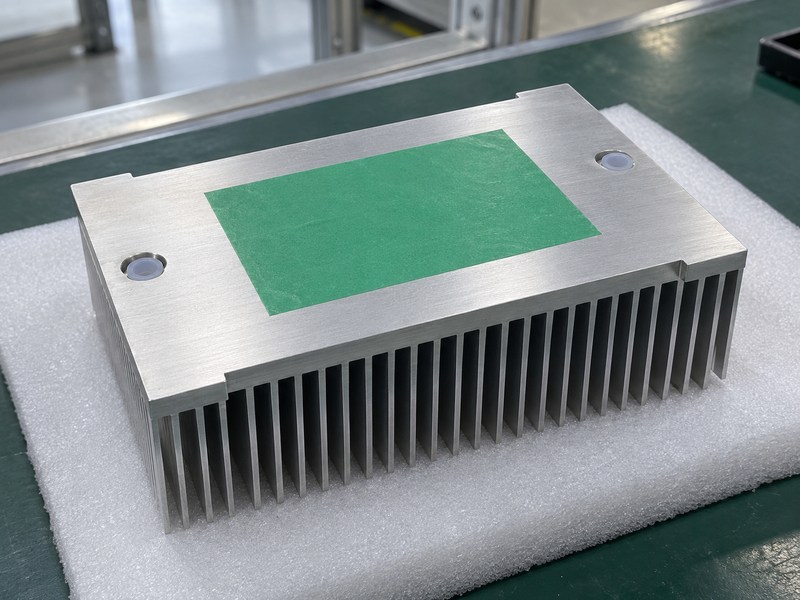
Sandblasting aluminum heat sink parts should leave protected features within their drawing limits, including thermal lands, threads, locating bores and sealing surfaces. On power electronics assemblies, a clean-looking base still needs the specified contact geometry. Use a marked drawing to show masking boundaries. Tell the supplier whether an edge transition or local machining step will follow removal of the mask.
Can one mask serve every finishing step?
A mask suitable for abrasive exposure may not suit a later chemical process or temperature cycle. Review each operation separately and verify that removal leaves no adhesive or plug fragments. If blasting occurs before final machining, identify which surfaces will be restored and how much machining stock remains. Protect a liquid cold plate’s ports and seals through its own approved route; an air-cooled fin specification cannot define internal fluid cleanliness.
- Identify every protected feature on the drawing.
- Inspect the boundary after mask removal.
- Keep adhesive away from final contact lands.
| Feature | Protection decision | Final check |
|---|---|---|
| Thermal land | Mask or finish-machine | Surface and flatness |
| Thread | Plug or approved method | Gauge and cleanliness |
| Seal face | Dedicated protection | Drawing-based inspection |
The final requirement applies after all masking, cleaning and subsequent finishing operations.
6. How clean must sandblasting aluminum heat sink parts be?
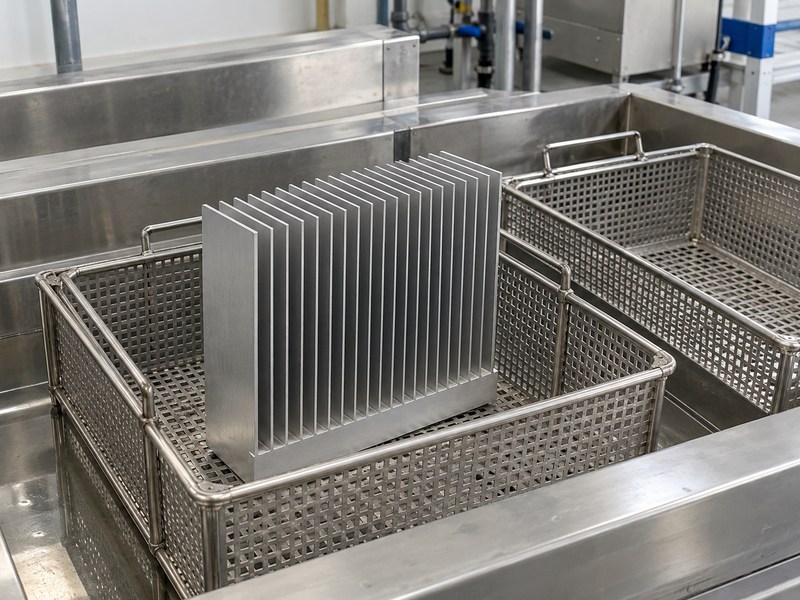
Sandblasting aluminum heat sink parts must meet the assembly’s agreed cleanliness requirement after blasting and every later operation. Loose particles in a fin channel can leave the part during installation or enter nearby electronics. Define an inspection method and acceptance limit that fit the application. A visual check may suit one product, while another requires a documented extraction or particle assessment agreed with the customer.
How do you verify the cleaning route?
Review how the supplier reaches channel roots, removes masking residue and dries sheltered areas. Check compatibility before specifying detergents, rinsing, ultrasonic cleaning or drying conditions. Blowing air across the outside cannot establish that a deep passage contains no retained media. For a trial, inspect the same difficult locations after cleaning and again after handling; this helps separate inadequate cleaning from contamination introduced at the next workstation.
- Keep finished parts separate from blast media.
- Define protection during storage and transport.
- Record the condition used for final inspection.
| Stage | Possible carryover | Evidence to request |
|---|---|---|
| Mask removal | Adhesive or fragments | Surface inspection |
| Channel cleaning | Abrasive particles | Agreed cleanliness check |
| Drying and packing | Moisture or new debris | Final condition record |
Acceptance should describe the condition delivered to assembly, not only the condition leaving the blast cabinet.
7. Does sandblasting aluminum heat sink work replace anodizing?
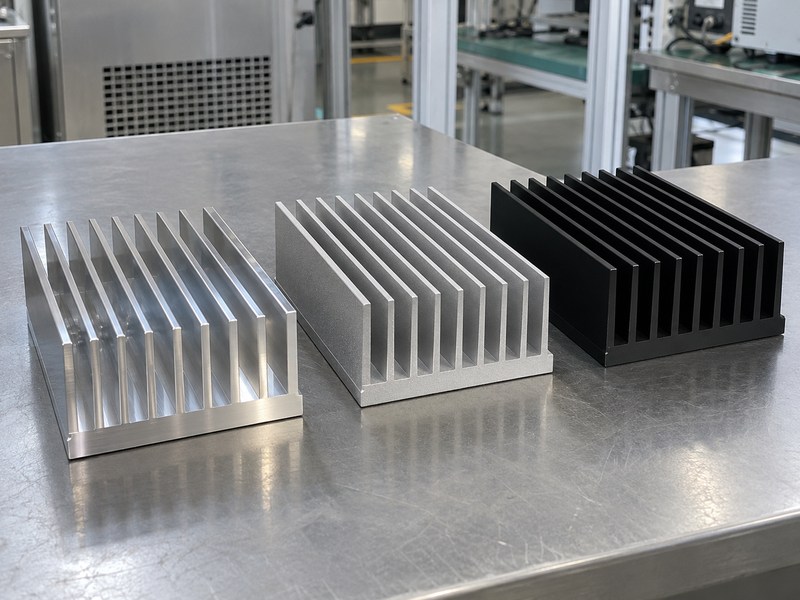
Sandblasting aluminum heat sink work does not replace an anodizing specification because blasting textures a surface while anodizing forms an oxide layer. Your heat sink finishing route should state whether the part remains bare or receives another treatment. Consider exposure, appearance, electrical contact and thermal interfaces together. A matte silver sample and a black anodized sample can look different while sharing the same underlying extrusion.
Which surfaces need separate treatment rules?
Define the coating requirements for external surfaces separately from mounting lands, grounding contacts and fastener interfaces. An anodized appearance cannot demonstrate a certified electrical insulation system. The manufacturer’s finish guidance also distinguishes finish options from insulation claims. Where electrical isolation is required, specify and test the actual insulating interface, clearances and assembly instead of assigning that duty to a color or surface texture.
- State the required coating and final condition.
- Identify conductive contact locations.
- Verify dimensions after the full sequence.
| Requirement | Blasting addresses | Separate decision |
|---|---|---|
| Matte texture | Surface appearance | Accepted sample |
| Environmental exposure | Limited surface preparation | Protective finish |
| Electrical isolation | No insulation qualification | Tested insulation system |
Review the finished assembly requirements before approving either a bare or coated sample.
8. Will sandblasting aluminum heat sink parts improve cooling?
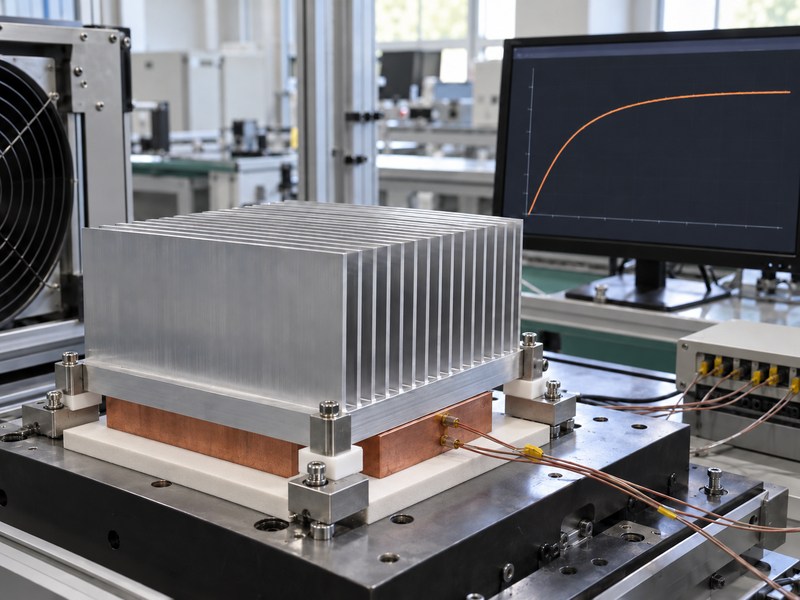
Sandblasting aluminum heat sink parts does not establish a cooling improvement without a controlled comparison. Surface finish can affect heat exchange, but airflow, fin geometry, temperature and contact resistance also govern the result. Test the intended assembly with equivalent mounting and operating conditions. A rougher surface can accompany worse cooling if the treatment damages a contact land or changes the thermal interface thickness.
What makes a comparison useful?
Hold heat input, inlet temperature, airflow, orientation, mounting load and interface material constant. Use consistent sensor locations and a documented steady-state criterion, then account for measurement uncertainty before claiming a small improvement. The nearby chart illustrates a stabilization trend; it supplies no measured performance values. If a test fixture removes substantial heat through its supports, quantify that path or change the fixture before attributing the result to the heat sink.
- Compare finished assemblies under matched conditions.
- Record power delivered to the heat source.
- Repeat assembly where interface variation matters.
| Test input | Keep comparable | Otherwise you may measure |
|---|---|---|
| Airflow | Same installed condition | Fan or duct differences |
| Interface | Same material and load | Contact variation |
| Fixture | Known heat leakage | Support conduction |
Report the measured conditions with the result so another engineer can assess whether the comparison applies.
9. How do you inspect sandblasting aluminum heat sink dimensions?
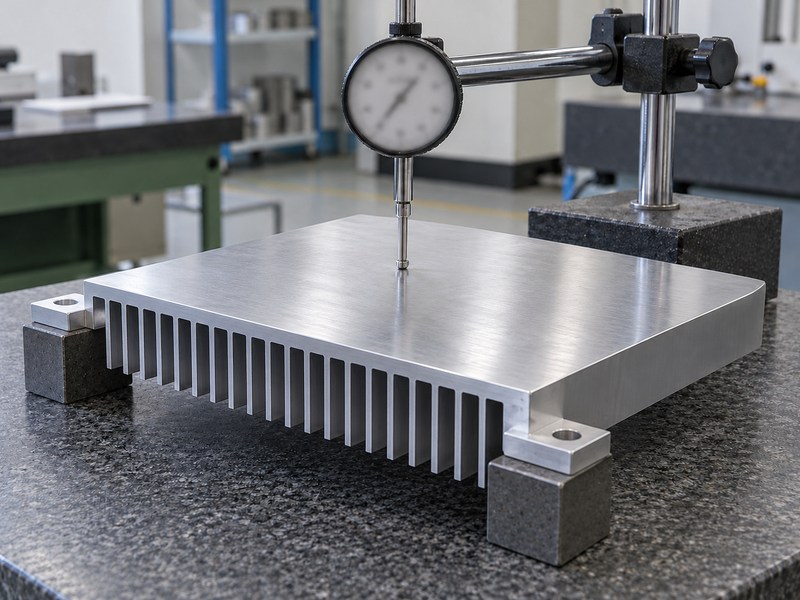
Inspect sandblasting aluminum heat sink dimensions after the complete process, using the drawing’s datum scheme and acceptance methods. For a custom industrial extrusion, prioritize base geometry, mounting features and fin clearances that affect assembly. Measure representative parts before and after finishing during qualification. That comparison separates pre-existing extrusion variation from changes introduced by blasting, cleaning or a later coating.
Which inspection errors should you avoid?
Do not support a delicate part in a way that bends it while measuring. Use a documented fixture and measuring force, and distinguish a simple indicator sweep from a complete geometric flatness evaluation. Calipers cannot replace a specified surface texture or flatness method. Where a reported value sits close to an acceptance limit, review instrument capability and uncertainty before deciding whether the process has passed.
- Record the final finishing condition.
- Check fin damage at handling points.
- Use the drawing revision on the report.
| Characteristic | Suitable evidence | Common mistake |
|---|---|---|
| Base geometry | Agreed measurement method | Uncontrolled support |
| Hole position | Datum-based inspection | Measuring from a cosmetic edge |
| Texture | Specified surface method | Judging roughness from a photograph |
Keep appearance approval and dimensional acceptance as separate entries on the inspection record.
10. How do you buy sandblasting aluminum heat sink parts?
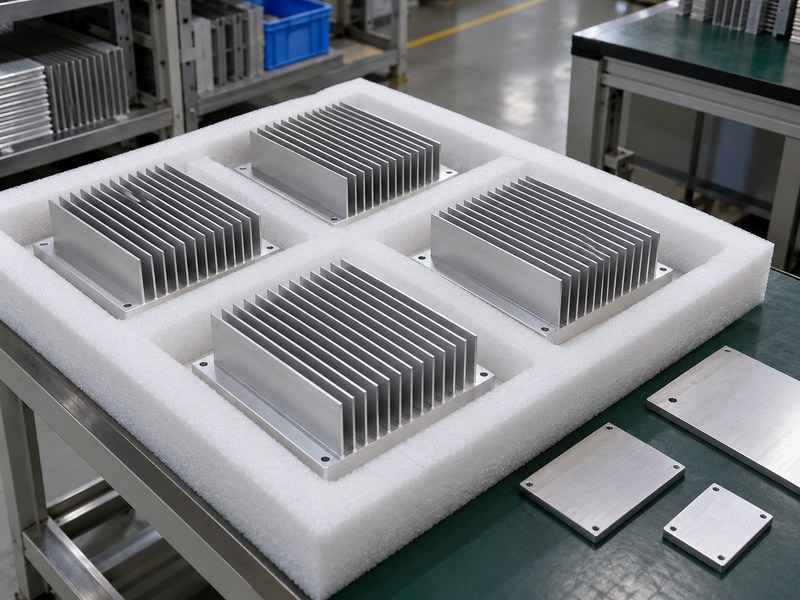
Buy sandblasting aluminum heat sink parts with a controlled drawing, an approved sample and a written process acceptance plan. Ask the supplier to separate material, machining, masking, finishing, cleaning and inspection costs. This helps you compare quotations with the same scope. A lower finishing price may exclude cleaning or protection that the assembly still needs, so reconcile those differences before placing the order.
What should approval cover before release?
Include the final material condition, finish boundaries, inspection results, packing method and change notification requirements. Keep a retained sample tied to its drawing revision and trial record. If the profile, media, equipment or finishing supplier changes, decide which checks must be repeated before accepting another batch. For engineering review, send the drawing, thermal load, airflow constraints and appearance target when you contact us.
- Approve a production-representative sample.
- Agree how nonconforming parts are handled.
- Require notice before process substitutions.
| Purchase item | Define before ordering | Keep with approval |
|---|---|---|
| Functional surfaces | Drawing limits | Inspection report |
| Appearance | Sample and viewing condition | Retained sample |
| Shipment | Individual part protection | Packing instruction |
Release production against those records and review changes before the next shipment.
Frequently asked questions
Q1: Can I blast the surface that touches a power module?
Only if the finished surface meets the module and interface requirements. Masking or final machining may be needed to preserve the specified flatness and texture.
Q2: What’s the best blast pressure for thin fins?
There is no universal setting. Qualify the complete equipment, media, support and exposure combination on production-representative geometry.
Q3: How do I know if media remains between fins?
Use an agreed cleanliness inspection that reaches the difficult areas. External appearance alone cannot demonstrate that deep channels are free of retained particles.
Q4: Can a matte finish prove better thermal performance?
No. Compare the intended assemblies at matched power, airflow, ambient conditions and mounting interfaces before making a performance claim.
Q5: What should I send with a quotation request?
Send the drawing revision, alloy and temper, quantity, masked features, final finish, cleanliness requirement and appearance reference. Include thermal operating conditions where they affect acceptance.