
Base a steel heat sink vs aluminum decision on the installed temperature, mass and environment your design must meet. Aluminum often suits the main heat path, while steel may provide useful structure or an existing cooling surface. Compare identified alloys and complete assemblies before treating material choice as settled.
1. How should steel heat sink vs aluminum be compared?
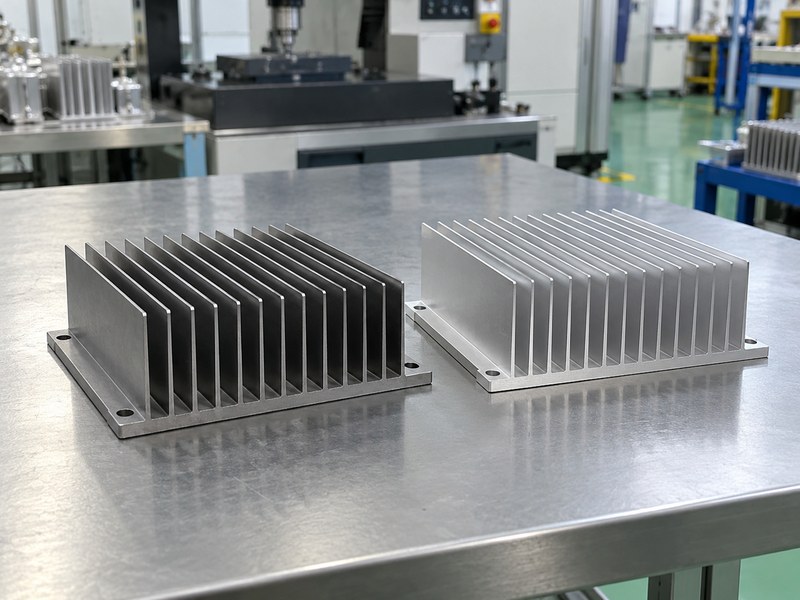
A steel heat sink vs aluminum comparison should distinguish a material experiment from a design-selection exercise. Identical geometry helps reveal material sensitivity. Allowing each material its own suitable geometry shows what you can buy or manufacture within the project’s actual space, mass and temperature limits.
Choose the question your comparison must answer
If you want to replace an existing aluminum part with steel, begin with the same geometry and the same installation. If the part can be redesigned, compare alternatives that meet the same duty rather than demanding an identical outline. These two studies may lead to different decisions without either being invalid.
An integrated steel heat sink vs aluminum study should also include the housing and its supports. A separate bracket, interface or cover can change both heat flow and the total part count.
- Hold the heat source, interface and cooling boundary constant in the baseline.
- State which dimensions can change during redesign.
- Compare installed source temperature rather than surface appearance.
| Comparison method | Hold constant | Useful result |
|---|---|---|
| Same geometry | Shape and operating conditions | Material sensitivity |
| Same envelope | Space and thermal target | Feasible optimized designs |
| Same system duty | All acceptance requirements | Procurement decision |
Label the method with every result so a redesigned part is not mistaken for a simple material substitution.
2. Why does the exact alloy change the result?
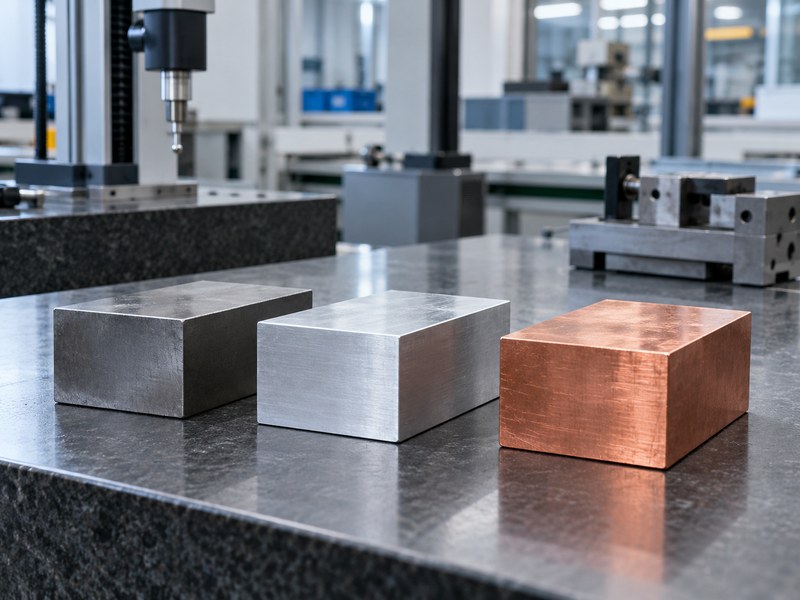
The exact alloy changes a steel heat sink vs aluminum result because conductivity, strength, corrosion behavior and fabrication differ within each metal family. Carbon steel is not interchangeable with austenitic stainless steel. Aluminum grades and conditions also differ, so a single “aluminum conductivity” value can misrepresent the chosen stock.
Put material identity into the comparison record
Request the grade, product form and material condition for both alternatives. Use properties applicable to the operating temperature and account for any joining or treatment that changes the finished part. A familiar grade name without its condition may still leave uncertainty in the model.
Published stainless material properties can support grade-specific review, but the supplied material still needs its agreed traceability. Do not identify an alloy from its color, finish or a quick magnet check alone.
- Separate carbon steel, stainless steel and aluminum grade assumptions.
- Record where each property value came from and its conditions.
- Review proposed substitutions before production rather than afterward.
| Material information | Why it matters | Needed record |
|---|---|---|
| Grade | Controls composition | Recognized designation |
| Condition | Affects properties and fabrication | Supplied material state |
| Temperature | Can affect model inputs | Relevant operating range |
Use a named material pair when asking a supplier to explain a performance difference.
3. How does conductivity change the temperature rise?
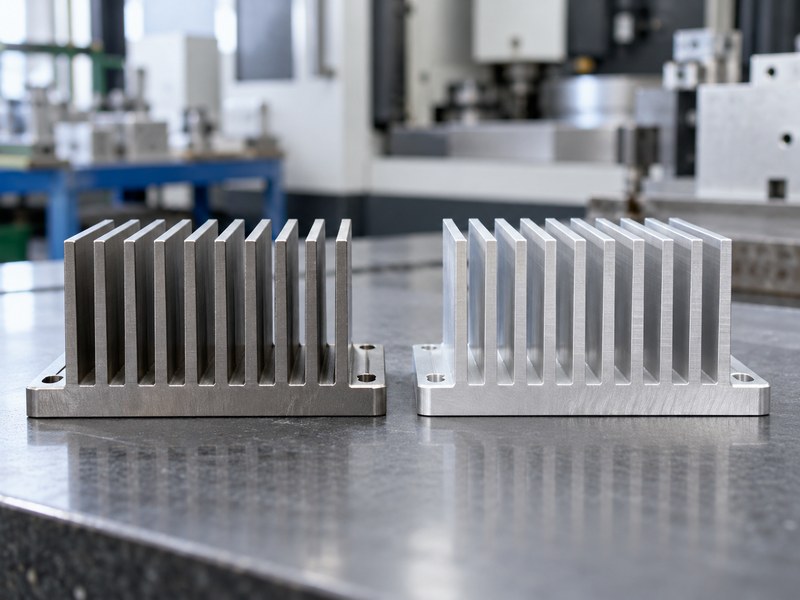
Conductivity changes the metal-path resistance in a steel heat sink vs aluminum comparison. For a uniform path, resistance is L/(kA), so a lower conductivity creates more temperature rise at the same heat flow. The importance of that difference depends on how much of the complete assembly resistance lies in the metal.
Compare the metal path and the whole assembly
For a worked example, assume a 4 mm path and 800 mm² area, with conductivities of 50 W/(m·K) for steel and 167 W/(m·K) for aluminum. The calculated path resistances are 0.10 and about 0.030 K/W. At 30 W, their path temperature rises are 3.0 and about 0.9 K.
Your steel heat sink vs aluminum model also needs spreading and interfaces. If the source is small or the heat must travel sideways, a simple through-thickness calculation can understate the material penalty.
- Use the real source footprint rather than the entire plate area automatically.
- Include contact and spreading resistance separately.
- Check whether air-side resistance dominates the total result.
| Example path | Assumed conductivity | Calculated resistance |
|---|---|---|
| Steel, 4 mm through 800 mm² | 50 W/(m·K) | 0.10 K/W |
| Aluminum, same path | 167 W/(m·K) | About 0.030 K/W |
These are illustrative inputs, not universal grade specifications or measured product ratings.
4. How much does mass change the assembly?
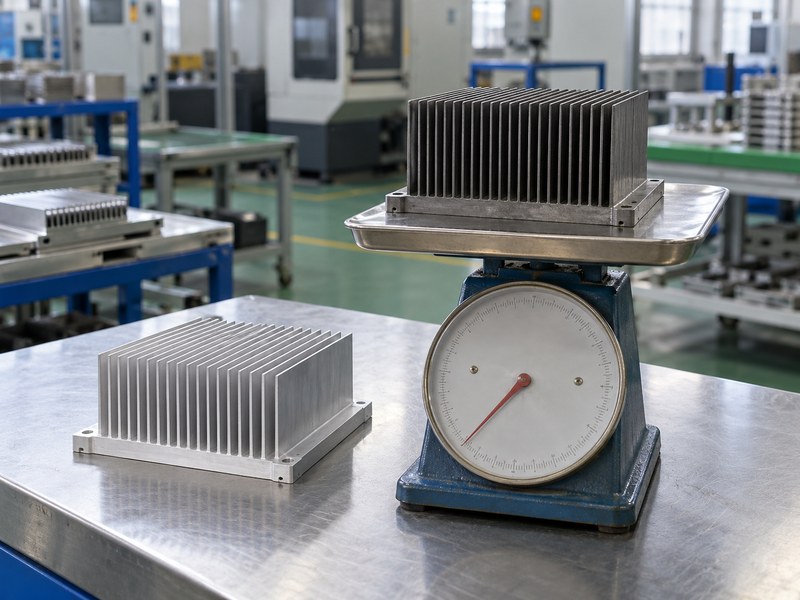
Mass can change a steel heat sink vs aluminum assembly even when the thermal difference appears manageable. A heavier component increases mounting and handling loads. It can also store more heat during a short pulse, which may make an early temperature check look better than the eventual continuous result.
Separate heat storage from heat rejection
For an illustrative equal-volume comparison, assume 100 cm³ of material and densities of 7.8 and 2.7 g/cm³. The calculated masses are 780 g and 270 g. These assumed values show why a material substitution needs a mounting review even before the cooling performance is tested.
Thermal mass can help a cycling load only if the assembly has time and a path to release stored heat. A part that warms slowly during one pulse can accumulate heat over repeated cycles.
- Include the cooling part’s mass in shock and vibration loads.
- Check the structure that supports it, not only the fastener size.
- Test recovery over the intended duty cycle.
| Requirement | Mass affects | Separate thermal check |
|---|---|---|
| Transport | Shock loading | Contact after handling |
| Operation | Mounting fatigue | Steady temperature |
| Pulsed duty | Stored heat | Recovery between pulses |
Select the material using both the supported mass and the repeated thermal cycle.
5. What changes when the design uses fins?
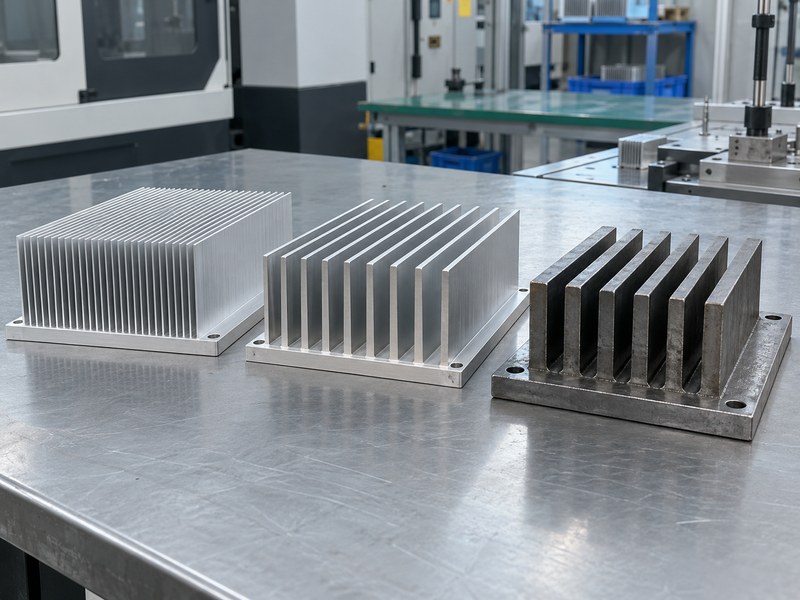
Fins make a steel heat sink vs aluminum comparison sensitive to conduction along each fin as well as exposed area. A fin’s tip may remain much cooler than its base. Counting every square millimeter as though it were at base temperature can overpredict cooling, especially with long thin fins.
Match fin shape to the material and cooling boundary
Fin efficiency expresses the useful heat transfer relative to an ideal uniformly hot fin. It depends on conductivity, cross-section, length and the surrounding convection. A steel part may need a different thickness or height from an aluminum design rather than a direct copy of its profile.
Review a steel heat sink vs aluminum layout with its air path intact. Dense fins may add area while increasing flow resistance or reducing natural-convection clearance; the fan and enclosure determine whether that area is useful.
- Compare base-to-tip temperature distribution in the model or test.
- Evaluate fin pitch with the actual airflow source.
- Preserve cleaning access where dust or process residue is expected.
| Geometry change | Helps | Can also change |
|---|---|---|
| Thicker fin | Conduction along the fin | Mass and open area |
| Shorter fin | Temperature uniformity | Available surface area |
| Wider pitch | Air access and cleaning | Fin count |
Choose fins from the installed resistance result rather than a surface-area total alone.
6. Which material handles the environment better?
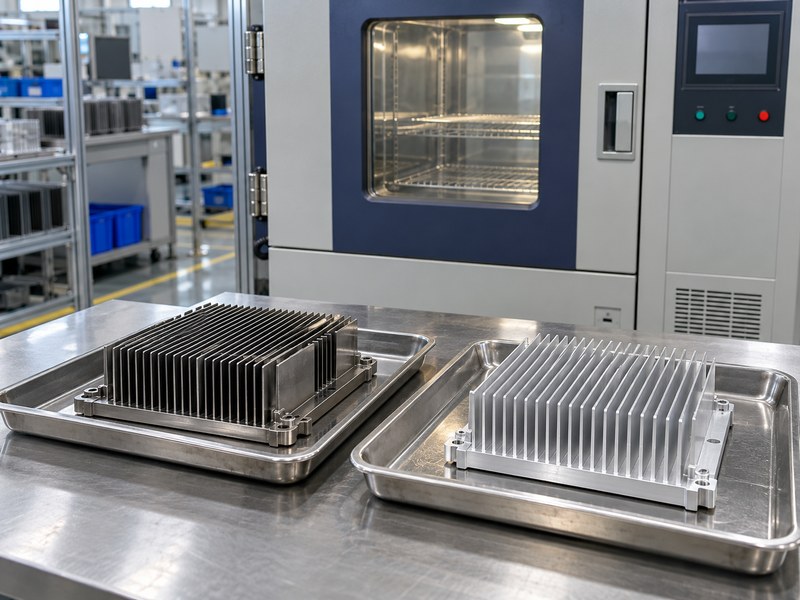
Environmental suitability in a steel heat sink vs aluminum decision depends on grade, finish and the actual exposure. Carbon steel may need a protective system, while stainless and aluminum have their own limitations. Cleaning chemicals, salts, moisture and crevices can matter more than a general description such as “outdoor use.”
Review exposed faces and interfaces separately
A coating suitable for the outer surface may add resistance or change fit at a thermal interface. Define which areas receive the finish and which require a controlled contact condition. Include edges, holes and joined areas in the review rather than checking a flat exterior panel alone.
When different metals contact each other, evaluate the environment and the complete assembly. Galvanic behavior cannot be established from a dry tabletop photograph or an isolated material coupon.
- State chemical exposure, temperature and cleaning conditions.
- Define finish coverage and any required masking.
- Include joints and fasteners in the corrosion assessment.
| Location | Question | Design response |
|---|---|---|
| Outer surface | What exposure reaches it? | Suitable alloy and finish |
| Contact face | What resistance and fit are allowed? | Controlled interface condition |
| Crevice or joint | Can liquid remain there? | Drainage and compatibility review |
Use a qualification plan that represents the assembly’s actual exposure.
7. Can steel and aluminum work in the same design?
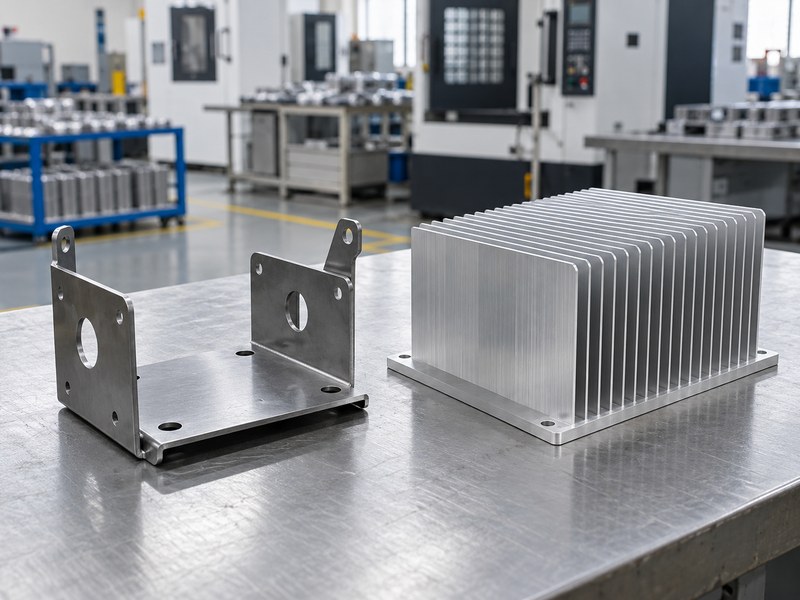
Steel and aluminum can work together when the steel heat sink vs aluminum question is resolved by assigning different functions to different parts. Steel can provide a structural housing or support, while an aluminum heat sink carries much of the heat. The interface between them still needs a defined duty and assembly method.
Decide whether heat must cross the joint
If the aluminum part contacts the heat source directly, the steel structure may carry little of the intended heat flow. If heat enters through a steel wall, that wall and its interface remain part of the thermal path. The same two materials can therefore produce different results depending on their arrangement.
Select steel heat sink vs aluminum retention to maintain the required contact while accommodating the mounting stack. Do not assume the fastener or interface material can correct an uncontrolled gap.
- Draw the intended heat path through every material and joint.
- Identify which part carries structural and service loads.
- Review expansion, insulation and environmental compatibility together.
| Arrangement | Thermal task | Check |
|---|---|---|
| Steel support, direct aluminum cooling | Source contacts aluminum | Retention and exposure |
| Heat through steel wall | Wall remains in the path | Wall and interface resistance |
| Separate frame and cooling module | Functions partly independent | Assembly loads and access |
Compare the combined assembly with single-material alternatives using the same source-temperature target.
8. How should you compare manufacturing cost?
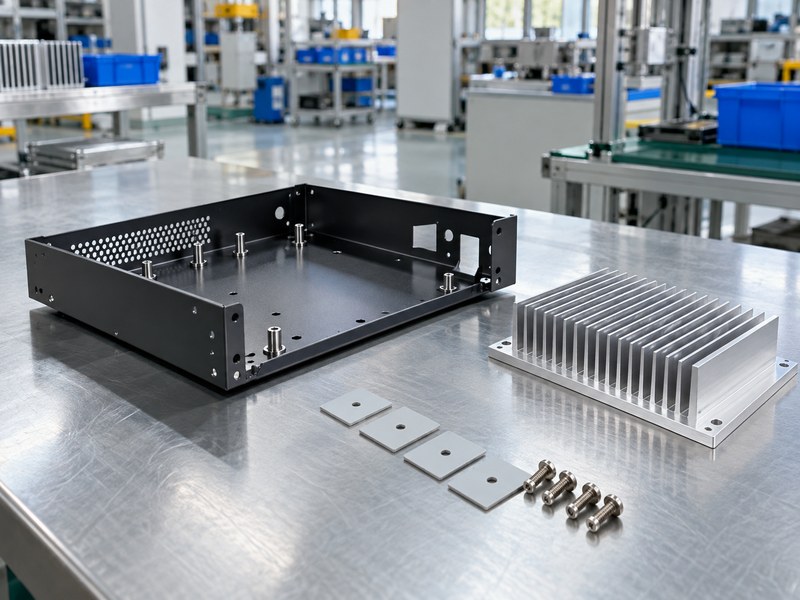
Manufacturing cost in a steel heat sink vs aluminum comparison includes the finished geometry, process route and inspection. Raw stock price is one input. Machining time, tooling, joining, finishing, rejected parts and added support can change the total cost of the installed design.
Quote the same acceptance scope
An aluminum extrusion with secondary machining is a different manufacturing proposal from a fully machined steel block. A formed steel enclosure that already exists in the product may have a different cost case from adding a separate steel cooling component. Compare the parts and operations actually required by each design.
Ask suppliers to identify tooling and non-recurring work separately from unit price. Keep quantity, material traceability and final inspection conditions consistent so a lower quotation does not merely omit required work.
- Include finishing, masking and final contact-face inspection.
- Account for extra brackets, fasteners and interface materials.
- Compare production and service costs at the intended quantity.
| Cost element | Include | Reason |
|---|---|---|
| Manufacturing | Material and all operations | Finished-part cost |
| Installation | Supports and assembly time | Installed cost |
| Qualification | Samples and agreed testing | Approval cost |
Use itemized quotations to test a cost assumption before changing the material specification.
9. How do you run a fair thermal comparison?
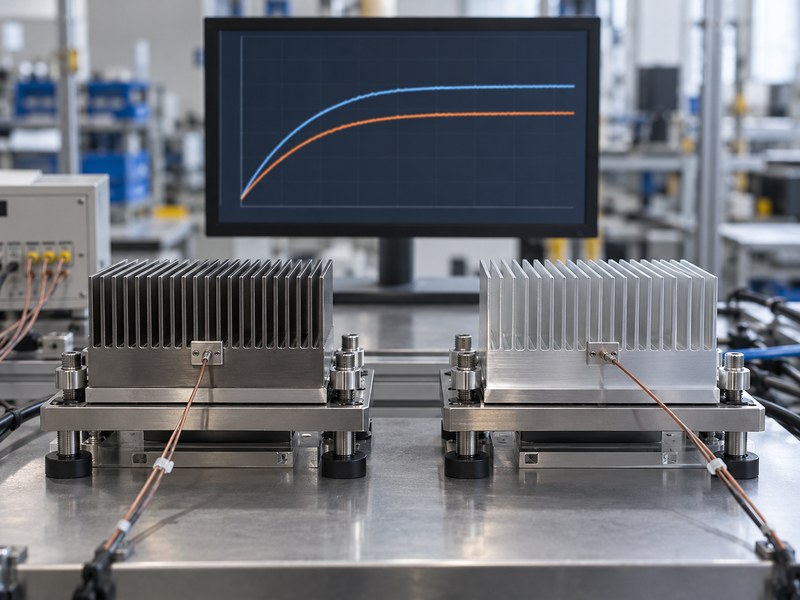
A fair steel heat sink vs aluminum test uses controlled heat input, comparable interfaces and documented cooling conditions. Record local air temperature and sensor positions. A different surface finish can also affect infrared readings, so apparent color or displayed temperature alone may be misleading.
Measure the result your product must meet
Use the component or source-temperature criterion that governs the design. If both parts operate at 30 W and one assembly shows a 36 K source-to-local-air rise, its measured assembly resistance is 1.2 K/W under those conditions. Compare that result with the other assembly using the same boundary and stabilization method.
When neither steel heat sink vs aluminum alternative fits the available air-cooling space, review a different architecture. A cold plate comparison needs its coolant temperature, flow and pumping conditions recorded as well.
- Match source footprint and contact preparation in the baseline.
- Record parasitic heat paths through fixtures or supports.
- Repeat assembly when mounting variation could change the result.
| Test variable | Hold or record | Avoid |
|---|---|---|
| Heat input | Known applied power | Comparing different loads |
| Interface | Material and assembly method | Uncontrolled contact changes |
| Cooling boundary | Local air or coolant condition | Using room temperature alone |
Keep the setup description with the data so another engineer can reproduce the comparison.
10. What should decide the final material choice?
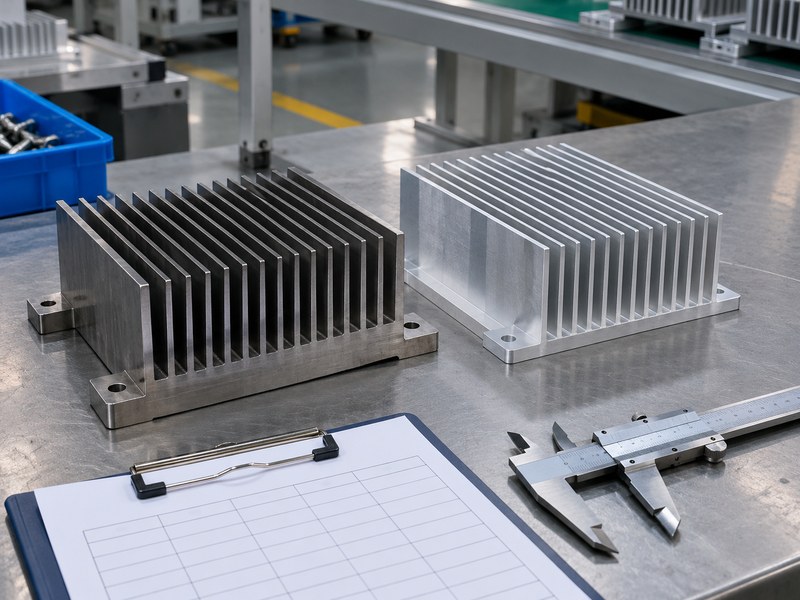
The final steel heat sink vs aluminum choice should satisfy the thermal, mechanical and environmental limits at an acceptable installed cost. A superior conductivity value is useful only within a design that can be manufactured, supported and maintained. Record the reason for the choice so later substitutions do not discard its assumptions.
Turn the comparison into purchasing requirements
Give suppliers the heat load, source layout, envelope, local ambient and mounting conditions. Include the accepted alloy, finish and verification method for each proposed route. If geometry can change, state the freedoms clearly and ask suppliers to identify the tradeoffs their proposal makes.
Send the drawing and operating conditions when you contact us. We can review heat sink, mounting and cold plate options against the same temperature target before the project commits to a material route.
- Eliminate options that fail a mandatory acceptance requirement.
- Compare the remaining installed costs and service needs.
- Freeze the material and test configuration with the approved sample.
| Decision gate | Evidence | Purchasing record |
|---|---|---|
| Thermal | Defined-condition result | Accepted setup and limit |
| Mechanical and exposure | Relevant qualification | Material and finish scope |
| Cost and supply | Comparable quotation | Approved production route |
Require engineering review when a later change affects any of these gates.
FAQ
Q1: Is aluminum always better than steel for a heat sink?
No. Aluminum often offers a useful conductive path and lower mass, but an existing steel structure or a specific exposure requirement can change the assembly decision. Compare the complete duty.
Q2: Can I use the same fin design for both materials?
You can use it for a controlled comparison, but it may not suit both materials equally. Fin thickness, height and pitch should be reviewed before choosing a production design.
Q3: Does a heavier steel part prove better cooling?
No. Higher mass can slow the initial temperature rise while the continuous temperature remains too high. Test the intended duty cycle and allow the assembly to reach its defined operating condition.
Q4: How do I compare quoted thermal resistance values?
Check the reference temperatures, source size, interface, orientation and cooling boundary. Values obtained under different conditions do not establish a fair material comparison.
Q5: Can a steel frame support an aluminum heat sink?
Yes, with suitable retention and a reviewed interface. Define whether the frame also carries heat, and include expansion, electrical and environmental conditions in the assembly assessment.