
Choose a steel heat sink by checking its heat path, grade, exposed area and mounting conditions against a temperature limit. A strong bracket can still leave electronics running hot. Start with the thermal budget, then decide whether steel should carry heat, support another cooling component, or do both.
1. What does a steel heat sink do?
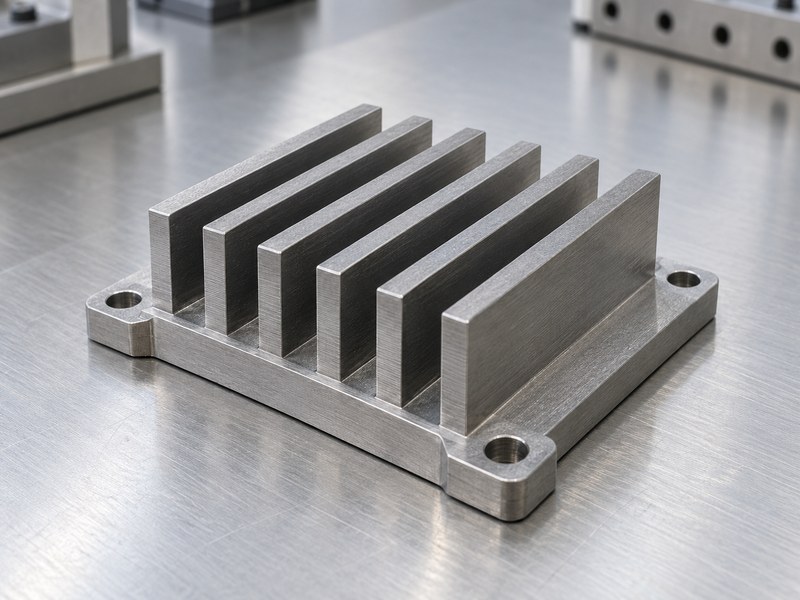
A steel heat sink conducts heat away from a source and releases it through exposed surfaces or a connected cooling assembly. Its usefulness depends on temperature rise under load. A heavy part that warms slowly may provide temporary heat storage without removing enough heat during continuous operation.
Separate cooling duty from structural duty
A machine enclosure can combine shielding, mounting and heat rejection in one steel part. That arrangement saves joints, but it also ties thermal performance to panel thickness, contact pressure and ventilation. For a compact drive module, you may instead need a conductive insert attached to a steel frame.
Check the complete steel heat sink assembly rather than judging a loose metal sample. A large panel with blocked airflow can perform worse than a smaller part exposed to moving air.
- Record continuous heat loss and the duration of overload pulses.
- Identify where heat enters and where it can leave.
- Keep structural loads separate from fragile electronic package limits.
| Duty | Useful feature | Check before approval |
|---|---|---|
| Continuous cooling | Exposed area and airflow | Steady operating temperature |
| Short heat pulse | Thermal mass | Recovery before the next pulse |
| Mechanical support | Stiffness and mounting area | Contact remains flat under load |
Specify these duties separately so a successful strength test does not substitute for a thermal test.
2. How does a steel heat sink move heat?
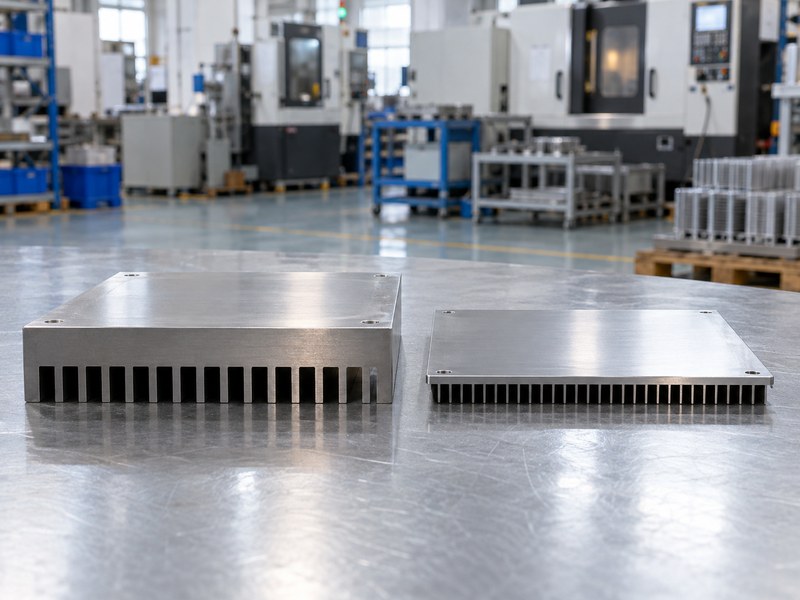
A steel heat sink moves heat through its base before convection and radiation carry that heat into the surroundings. A longer conduction path or smaller cross-section creates more temperature difference for the same heat flow. Extra mass alone does not reduce this steady conduction resistance.
Calculate the path before adding material
For a uniform one-dimensional path, R = L/(kA). As an illustrative calculation, use L = 0.003 m, A = 0.001 m² and an assumed k = 50 W/(m·K); resistance is 0.06 K/W. At 40 W, that path adds 2.4 K before contact and air-side losses.
This calculation excludes lateral spreading, bolt holes and uneven heat input. A small hot component on a much wider plate needs a spreading assessment, because its full plate area is unavailable immediately below the source.
- Shorten the distance between the heat source and exposed surface.
- Preserve conductive material beneath concentrated heat sources.
- Treat joints and interface layers as separate resistances.
| Example input | Assumption | Calculated result |
|---|---|---|
| Path length | 3 mm | Short through-thickness path |
| Conductive area | 1,000 mm² | Uniform contact assumed |
| Conductivity | 50 W/(m·K) | 0.06 K/W conduction resistance |
Use the actual alloy properties and source footprint before releasing a drawing.
3. Which grade suits a steel heat sink?
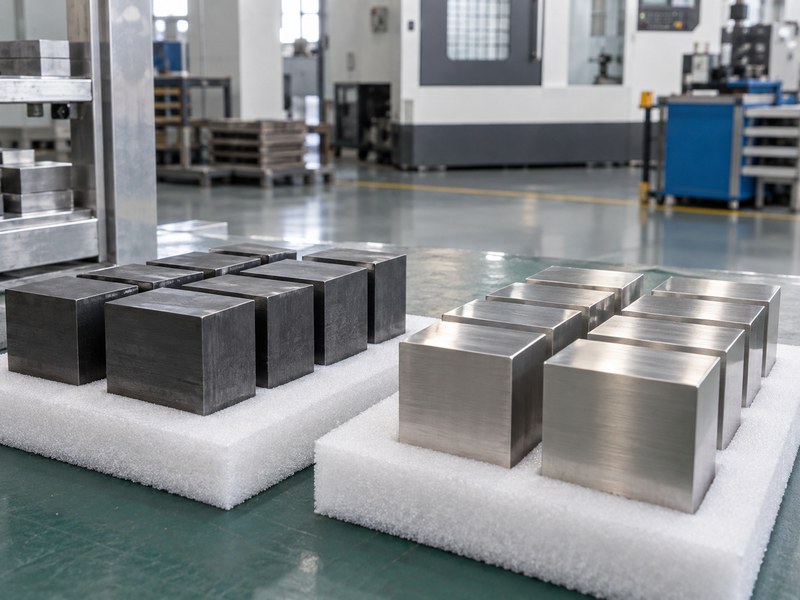
The right steel heat sink grade meets the corrosion and strength requirements while keeping conduction losses acceptable. Carbon steel and stainless steel differ in chemistry, corrosion behavior and thermal conductivity. A purchase order that says only “steel” leaves too much room for substitution.
Tie the grade to the environment
Specify a recognized grade, material condition and accepted certification route. Compare the grade against published stainless material properties where stainless is proposed. Dry indoor machinery, washdown equipment and a coastal installation expose metal to different conditions. Define where paint, plating or passivation belongs rather than applying a blanket finish note.
If your steel heat sink needs tight contact geometry, ask the supplier how stock condition, machining and subsequent treatment affect distortion. A chemically suitable alloy still needs a workable production route.
- Identify cleaners, humidity, salts and expected operating temperature.
- Request grade traceability for production material, not a sample alone.
- State whether substitutions require a thermal and corrosion review.
| Requirement | Drawing or purchasing detail | Verification |
|---|---|---|
| Alloy identity | Grade and product form | Material documentation |
| Environment | Exposure and cleaning conditions | Suitable qualification plan |
| Consistent supply | Approved substitution policy | Lot traceability |
Approve the grade and finish together because they govern the same exposed and contacting surfaces.
4. How should a steel heat sink compare with aluminum?
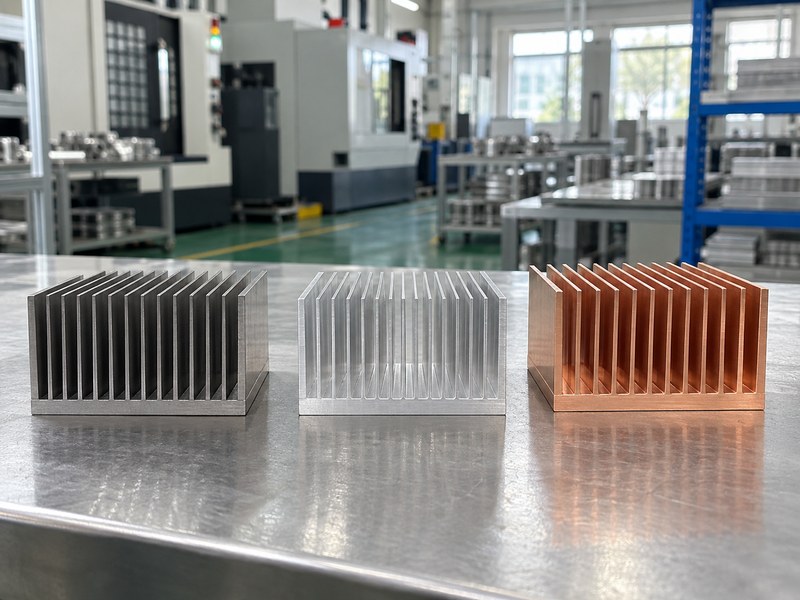
A steel heat sink should be compared with aluminum at the same heat load, temperature limit and installation conditions. Identical geometry isolates material effects, while redesigned geometry shows what each material can achieve within your space and cost limits. Both comparisons answer useful but different questions.
Use two comparisons rather than one shortcut
Start with a shared model to locate conduction bottlenecks. Then allow changes to base thickness, fin pitch and mounting geometry, since a steel design copied from an aluminum extrusion may be a poor use of steel. Include mass and support requirements when assessing the finished assembly.
Avoid comparing an open-bench steel part with an aluminum part inside a cabinet. Air temperature beside the fins, fan operating point and nearby obstructions can outweigh a small geometric change.
- Match source size, power and interface material in the baseline test.
- Record both component temperature and local cooling-air temperature.
- Compare the redesigned alternatives against the same acceptance limits.
| Comparison | Keep constant | What it tells you |
|---|---|---|
| Same geometry | Shape, heat input and airflow | Material sensitivity |
| Same envelope | Available space and temperature limit | Practical design capability |
| Same project | Cost, mass and qualification scope | Procurement suitability |
Choose the assembly that passes the application limits rather than the sample that looks more substantial.
5. Which fins work on a steel heat sink?
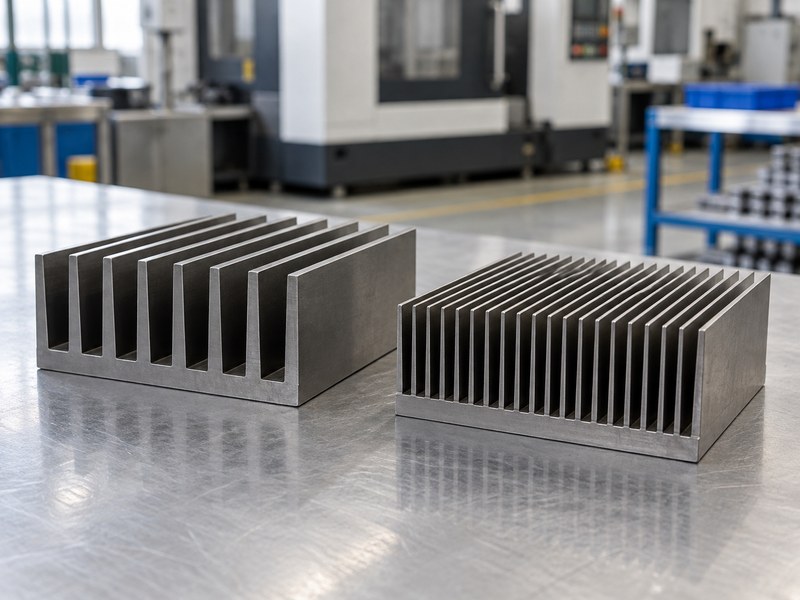
Steel heat sink fins work when heat reaches their exposed area and air can pass between them. Tall, thin fins can remain much cooler near their tips than at the base. Adding surface area then produces less cooling benefit than a uniform-temperature model predicts.
Match geometry to the available airflow
Shorter or thicker fins can improve fin efficiency, but they also alter area, weight and pressure drop. Natural convection needs an open route for buoyant air. Fan cooling needs a design matched to the fan’s operating point inside the actual enclosure.
Review a steel heat sink with its covers and neighboring components in place. An attractive dense fin array can become difficult to clean or can divert air around the cooling surface.
- Leave clearance at channel entries and exits.
- Account for dust accumulation and maintenance access.
- Evaluate fin temperature variation rather than area alone.
| Design change | Potential benefit | Tradeoff to evaluate |
|---|---|---|
| Shorter fins | Lower tip-to-base temperature difference | Less exposed area |
| Wider spacing | Easier airflow and cleaning | Fewer fins in the envelope |
| Thicker fins | Better conduction along each fin | More mass and less open area |
Select fin geometry using thermal resistance and airflow data under the intended orientation.
6. How can a steel heat sink be manufactured?
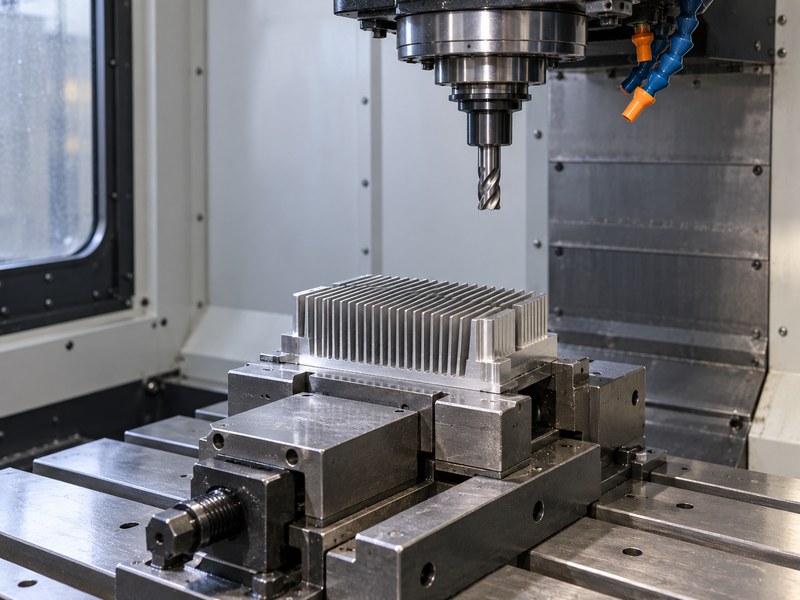
A steel heat sink can be machined, formed or assembled, depending on its geometry and production volume. Each route creates different limits for thin features, joint quality and flatness. The lowest raw material price does not establish the lowest finished-part cost.
Keep the production route visible on the drawing
Machining offers direct control over local features, although deep narrow slots increase tool reach and chip-removal demands. Formed or attached fins can reduce material removal, but their joints require a defined thermal and mechanical acceptance method. Welding can distort a contact face that was flat beforehand.
Ask which surfaces will be finished after joining or treatment. Critical datums should be accessible in the final inspection condition, and the supplier should be able to explain how they maintain that condition across a batch.
- Review cutter access, root radii and deburring access.
- Identify every joint in the source-to-air heat path.
- Define final flatness after all distortion-producing operations.
| Route | Typical design concern | Inspection focus |
|---|---|---|
| Machined part | Tool access and residual stress | Final contact geometry |
| Formed part | Springback and thickness variation | Mounting repeatability |
| Joined assembly | Contact quality and distortion | Joint integrity and flatness |
Compare quotations against the same finished geometry and inspection scope.
7. How should a steel heat sink be mounted?
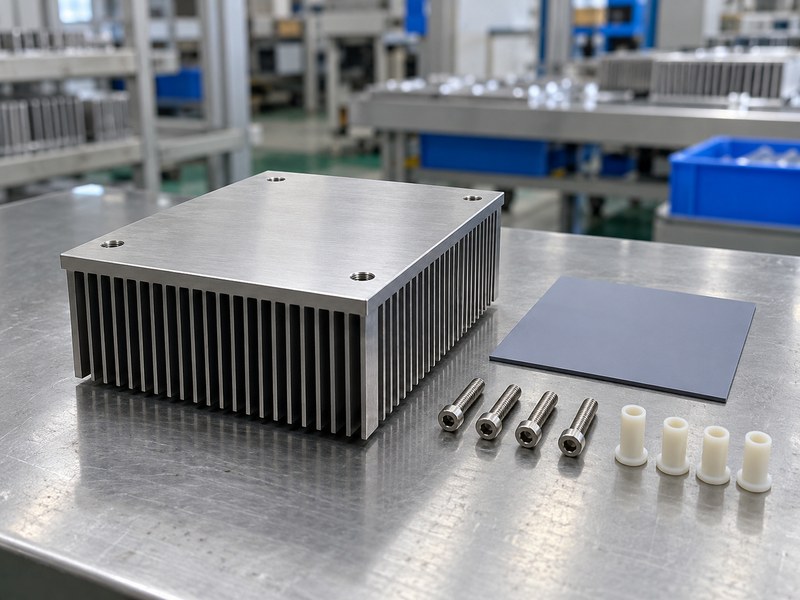
A steel heat sink needs a flat, controlled interface and a fastening system that maintains contact without overstressing the component. Bolts provide retention, while the interface material fills small surface gaps. A thick pad cannot reliably correct an uncontrolled bowed mounting face.
Specify pressure and insulation as assembly requirements
Package limits govern clamping force and allowable stress. A conductive mounting screw can defeat an insulating pad unless the entire fastening path is isolated where required. Verify the electrical design with the package data and the assembly’s insulation requirements.
Choose steel heat sink hardware for the stack thickness and service conditions. Spring elements can help accommodate movement, but their force range and travel still need calculation and qualification.
- State the approved interface material and compressed thickness.
- Define tightening sequence and a validated assembly setting.
- Inspect for burrs, trapped debris and edge contact before fastening.
| Interface issue | Consequence | Practical control |
|---|---|---|
| Bowed base | Uneven contact | Final-condition flatness inspection |
| Excess clamp load | Package or board damage | Package-specific assembly limits |
| Uninsulated fastener | Electrical connection across insulation | Review the complete current path |
Validate the assembled stack because separate component checks cannot establish interface performance.
8. When does a steel heat sink need liquid cooling?
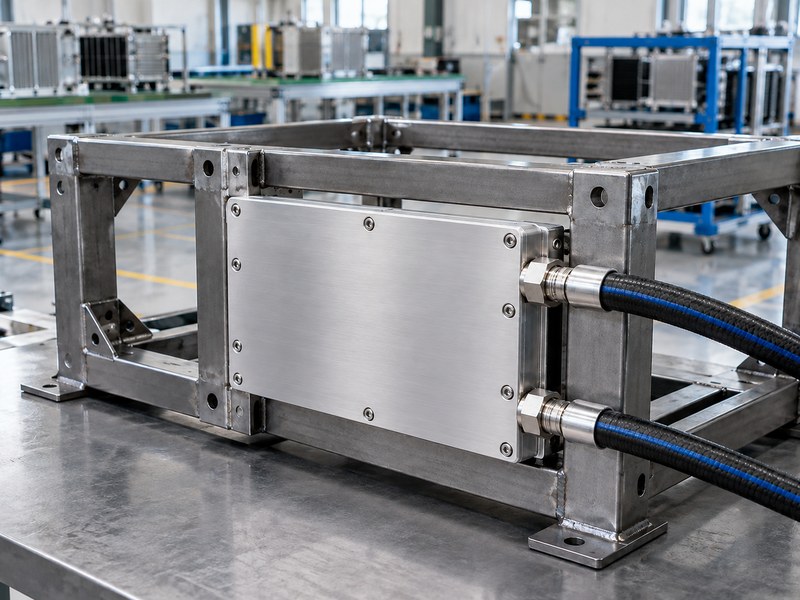
A steel heat sink needs a different cooling route when its practical air-cooled design cannot meet the temperature limit. Liquid cooling can remove heat through a cold plate while steel provides structural support. The liquid circuit introduces its own flow, pressure, leak and compatibility requirements.
Decide where steel belongs in the heat path
Passing coolant through stainless tubing does not remove the resistance between the heat source and that tubing. Tube wall thickness, contact area and joining method still affect source temperature. A separate conductive spreader can shorten this path without making the whole structure from one material.
Check coolant condition and service access before choosing a mixed-metal assembly. Galvanic compatibility depends on the wetted materials, coolant chemistry and system conditions; a photograph of clean components cannot establish long-term compatibility.
- Define inlet temperature, flow range and allowable pressure drop.
- Specify pressure boundaries, connector types and leak acceptance.
- Include pump-off behavior and maintenance access in the review.
| Cooling approach | Useful when | Additional requirement |
|---|---|---|
| Air cooling | Available airflow meets the thermal budget | Clear intake and exhaust |
| Cold plate with steel frame | Structure and heat path need different materials | Controlled interfaces |
| Stainless wetted circuit | Fluid-side exposure requires it | Chemistry and pressure validation |
Choose liquid cooling from the system requirements rather than a nominal wattage threshold.
9. How do you test a steel heat sink?
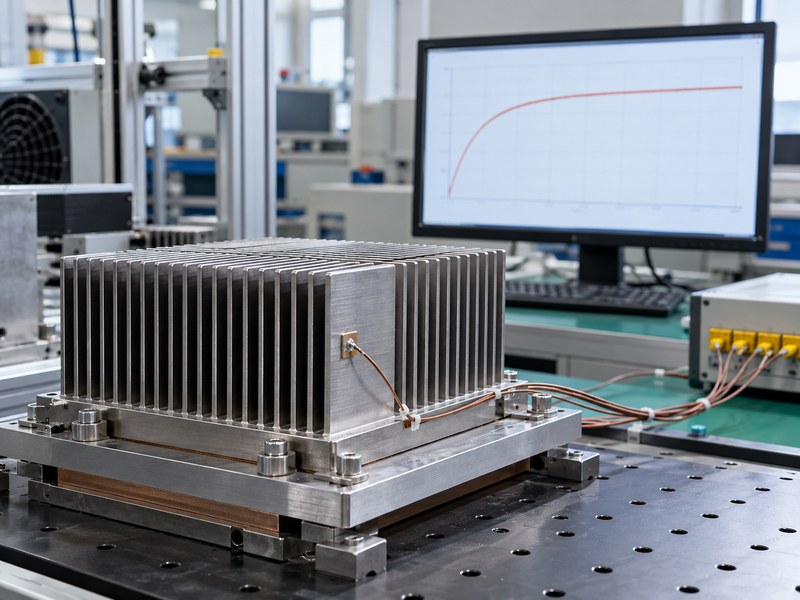
Test a steel heat sink by applying known heat input and measuring temperatures after the defined operating condition stabilizes. Calculate assembly thermal resistance from the appropriate temperature difference divided by heat flow. Sensor placement and heat escaping through fixtures affect the result.
Write the test boundary before running the test
For an illustrative test, 30 W entering the assembly and a 24 K base-to-local-air rise give 0.8 K/W. This result describes that fixture, orientation and airflow. It cannot be transferred unchanged to a sealed cabinet or a different heat-source footprint.
If you compare an air-cooled steel heat sink with a hybrid alternative, use source temperature as the common acceptance measure. Report coolant conditions for the liquid design and local air conditions for the air-cooled design.
- Measure input power and identify significant alternate heat paths.
- Define stabilization and sensor attachment methods in advance.
- Repeat the assembly when contact variability could affect selection.
| Recorded item | Reason | Avoided mistake |
|---|---|---|
| Local air temperature | Defines the cooling boundary | Using distant room temperature |
| Source footprint | Controls spreading | Comparing different heater sizes |
| Assembly method | Controls contact resistance | Treating one mounting as universal |
Retain the setup description with the result so another engineer can reproduce the comparison.
10. What should a steel heat sink RFQ contain?
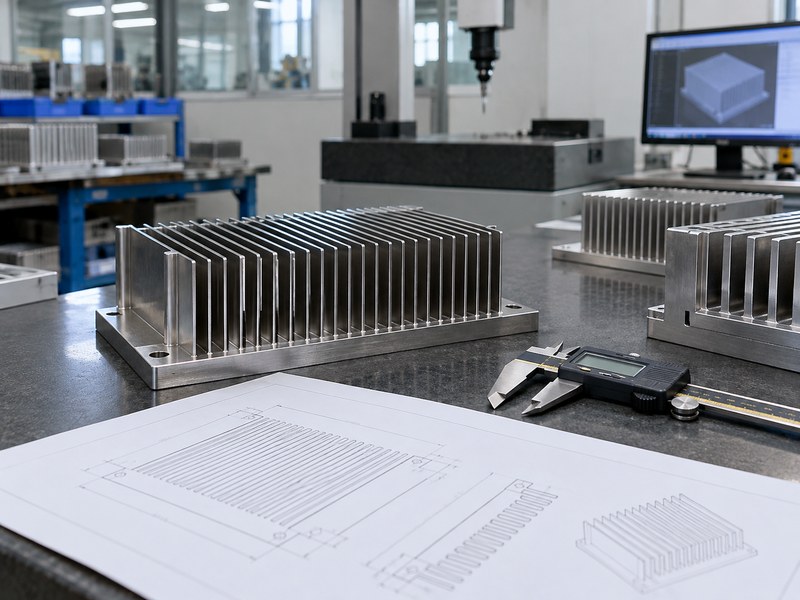
A steel heat sink RFQ should contain the thermal duty, environment, mechanical interfaces and measurable acceptance limits. A drawing establishes shape, but the supplier also needs operating conditions. Otherwise, two quotations can describe different cooling problems while appearing to offer the same part.
Ask for evidence tied to the supplied configuration
Include a source layout, available envelope, expected quantity and the reason steel is under consideration. Request a review of conduction bottlenecks and any proposed alternative before tooling or production. Define which changes require approval, including material, finish, joint method and interface stack.
Supply your load case and drawing when you contact us. We can discuss the heat sink, mounting or cold plate options relevant to the assembly, with the thermal target kept visible throughout the review.
- State normal and worst-case heat losses with ambient conditions.
- Identify datums, tolerances and surfaces that must remain uncoated.
- Agree on sample testing and production acceptance before ordering.
| RFQ input | Provide | Supplier response to request |
|---|---|---|
| Thermal target | Power, source layout and temperature limit | Proposed validation conditions |
| Mechanical scope | Drawing and mounting stack | Manufacturing and assembly review |
| Purchasing scope | Quantity, traceability and inspection | Comparable itemized quotation |
Resolve those points before approving the production sample.
FAQ
Q1: Can I use a steel plate as a heat sink?
Yes, if its conduction path and exposed surfaces keep your component within its temperature limit. Check continuous operation because thermal mass can conceal a slow temperature rise during a short test.
Q2: Is stainless steel a better heat sink than carbon steel?
Usually not for conduction alone. Select the exact grade using its properties and exposure requirements, then evaluate the finished assembly rather than assuming all steels behave alike.
Q3: Can I replace aluminum with steel without changing the design?
Only after a new thermal and mechanical review. The replacement changes conductivity, mass, corrosion behavior and possibly the mounting stack, even when its outline stays identical.
Q4: How do I know whether my steel heat sink is large enough?
Measure or predict the source temperature under the worst defined operating condition. Include interface resistance, real airflow, local ambient temperature and the required design margin.
Q5: Does a heavier steel heat sink always cool better?
No. More mass can absorb a short pulse, but sustained cooling requires a path for heat to leave. Check both pulse recovery and steady operating temperature when your load cycles.