
Choose a wire EDM aluminum heat sink when narrow, open-through fin channels justify its cutting time and meet your thermal target. A compact power stage may need close fin spacing while leaving little room for a milling cutter. Before paying for that geometry, check the wire path, available airflow, contact interface, and production quantity together. A manufacturable fin array still needs a thermal test under your operating conditions.
1. What is a wire EDM aluminum heat sink?
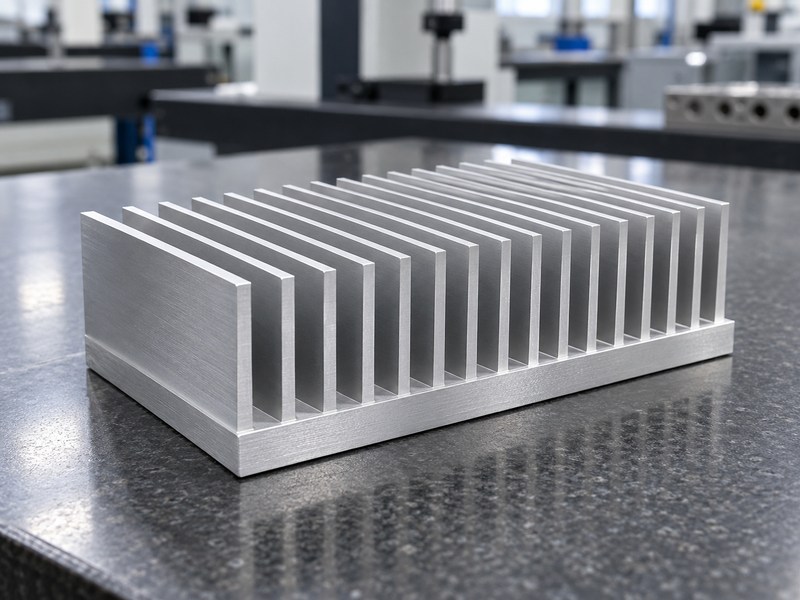
A wire EDM aluminum heat sink uses electrical discharges from a moving wire electrode to remove aluminum and form its heat-transfer geometry. The wire follows a programmed path through conductive stock while dielectric fluid supports machining and debris removal. For straight plate fins, the useful geometry is often a continuous comb-shaped cross-section cut through the part’s depth.
What does the wire change?
Start with the cut path. Wire EDM avoids the rotating cutter engagement used in milling, which can help with slender features and narrow openings. However, the setup still needs stable fixturing, electrical contact, wire access, and controlled flushing. Thin fins can move during handling or machining, so a drawing alone cannot establish process capability.
The machine manufacturer’s wire EDM tutorial explains why dielectric condition, wire handling, and finishing passes affect the result. Ask the supplier how those controls apply to your aluminum part.
- Show the complete wire travel direction.
- Identify the base that must remain intact.
- Agree where entry and exit marks are acceptable.
What should remain in the base?
Leave enough material beneath the slots for heat spreading, mounting loads, and any later face machining. Cutting fins does not establish the base thickness needed beneath a concentrated heat source.
| Feature | Purpose | Drawing check |
|---|---|---|
| Continuous base | Spreading and mounting | Remaining thickness |
| Open channels | Wire access and airflow | Through direction |
| Contact land | Device interface | Datum and flatness |
Key takeaway: Review the wire path and heat path on the same model.
2. Which wire EDM aluminum heat sink geometries work?
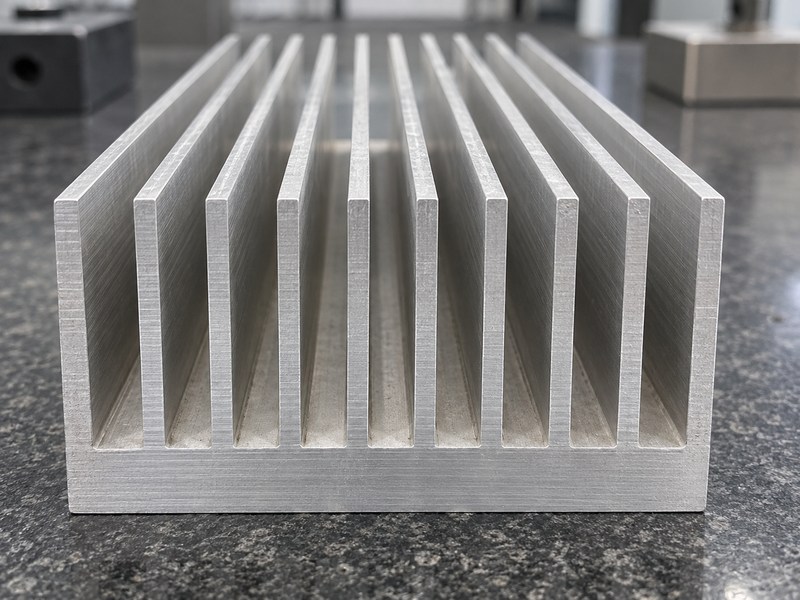
A wire EDM aluminum heat sink suits accessible through profiles, particularly straight channels that share a continuous cross-section. A conventional wire cannot stop inside solid material to create a closed-bottom blind pocket along its own travel direction. Orientation matters: a slot may stop above the base in cross-section while still passing completely through the part’s depth.
Can the wire reach every feature?
Trace one complete cut. A supplier should explain wire threading, approach clearance, workholding, and slug removal before accepting the model. An enclosed profile may require a start hole. A narrow gap also needs space for the wire and discharge gap, so nominal wire diameter alone does not define the finished slot width.
- Mark inaccessible internal corners.
- Separate through features from blind features.
- Check clearance around mounting bosses.
Which details need another operation?
Threads, counterbores, stepped mounting faces, and many pockets usually need drilling or milling. Include those operations in the route instead of pricing only the fin cuts. Otherwise, two attractive quotations may describe different finished parts and inspection scopes.
| Geometry | EDM review | Likely extra work |
|---|---|---|
| Open straight channel | Wire access | Edge finishing |
| Enclosed through profile | Start-hole access | Drilling |
| Blind mounting pocket | Different tool access | Milling |
Key takeaway: Quote the complete component, including features the wire cannot produce.
3. When should you choose milling, extrusion, or EDM?
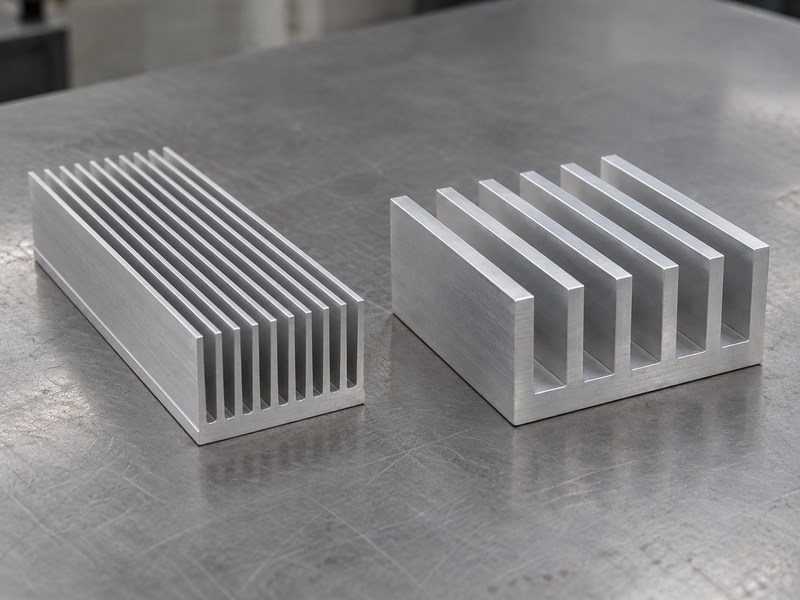
Choose a wire EDM aluminum heat sink when its difficult through features justify the machining route; compare milling and extrusion against the same finished specification. Milling suits accessible pockets and integrated mounting details. Extrusion can suit repeat orders with a constant profile, although die feasibility and later machining still need review.
What changes the cost comparison?
Price the accepted part. Cutting length, part depth, finishing passes, setup count, and inspection requirements influence an EDM quote. For an extrusion, include tooling, minimum order requirements, cut length, and interface machining. For milling, check tool reach, slender-tool deflection, cycle time, and whether the proposed cutter leaves acceptable internal radii.
- Compare sample and repeat-order quantities separately.
- Include finishing and inspection in every quote.
- Record any geometry changes proposed by each supplier.
Could two processes share the job?
A hybrid route may mill the base and mounting features before EDM cuts the fin profile. The operation order must preserve usable datums and workholding surfaces. Ask how the supplier will verify the part after material removal and finishing rather than assuming each operation leaves its earlier dimensions unchanged.
| Route | Useful fit | Cost question |
|---|---|---|
| Wire EDM | Difficult through profiles | Cut time and passes |
| Milling | Pockets and mounting details | Reach and cycle time |
| Extrusion | Repeated constant profiles | Tooling and volume |
Key takeaway: Select the route after comparing equivalent delivered parts.
4. Which alloy suits a wire EDM aluminum heat sink?
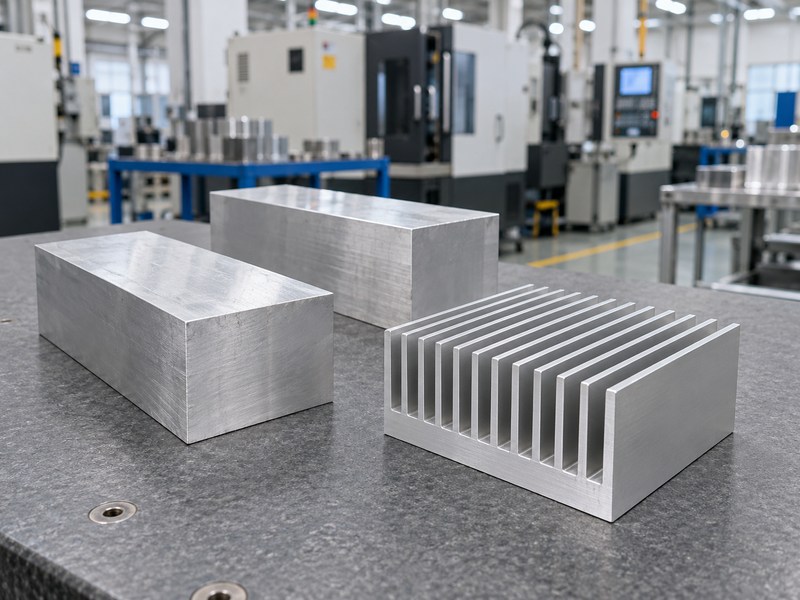
Specify the alloy and temper for your wire EDM aluminum heat sink around conductivity, mechanical loads, stock availability, and finishing requirements. Aluminum’s conductivity allows EDM, but different alloys do not provide identical thermal performance or surface behavior. A material substitution needs engineering approval even when its external dimensions match.
How should you compare common choices?
Keep the temper on the drawing. 6061-T6 is commonly used for machined structures with mounting features. 6063 is common in heat sink profiles, while higher-purity aluminum may suit a different balance of conductivity and strength. Stock condition, operating temperature, and mechanical requirements belong in the comparison alongside conductivity.
- Request the specified alloy and temper on material records.
- Confirm stock dimensions before freezing the route.
- Define whether substitutions require written approval.
What should you avoid assuming?
Do not infer an alloy from a silver surface or a conductivity value copied from another temper. Also, a thin base made from a more conductive alloy can still spread heat poorly if the source footprint is small. Compare the complete geometry with material properties appropriate to its actual condition.
| Selection input | Why it belongs | Evidence to request |
|---|---|---|
| Alloy and temper | Thermal and mechanical behavior | Material record |
| Stock condition | Machining stability | Supplier confirmation |
| Coating requirement | Finished interface | Finish specification |
Key takeaway: Freeze material identity before comparing thermal samples.
5. How should wire EDM aluminum heat sink fins handle airflow?
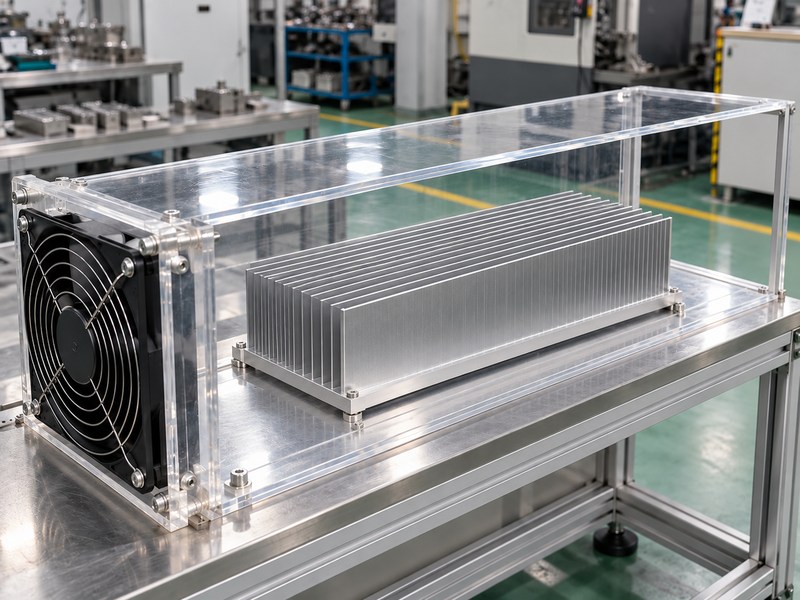
Set spacing for your wire EDM aluminum heat sink around the air that reaches its channels in the installed assembly. Closer fins add surface area, but they also increase flow resistance. A fan’s free-air rating cannot tell you how much air will pass through a restrictive fin array inside an enclosure.
Where does the air travel?
Check the installed flow path. Align straight plate-fin channels with the intended flow direction. Then review bypass gaps, inlet obstructions, outlet clearance, filters, and enclosure losses. With natural convection, orientation and open access for buoyant flow need separate attention; a forced-air fin arrangement may perform poorly without its fan.
- Review the fan curve against system resistance.
- Include expected filter restriction.
- Check where air can bypass the fins.
What should a spacing trial compare?
Compare candidate geometries under the same thermal load, source footprint, and enclosure conditions. Record installed airflow as an outcome of each geometry’s resistance. Holding velocity artificially constant can hide the penalty a denser fin array imposes on a real fan-driven system.
| Boundary | Record | Avoid substituting |
|---|---|---|
| Air supply | Installed operating point | Free-air rating |
| Fin channels | Direction and clearance | External fan position |
| Enclosure | Restrictions and bypass | An open-bench result |
Key takeaway: Choose fin density with the enclosure and fan, then validate that combination.
6. What finish and tolerance can you request?
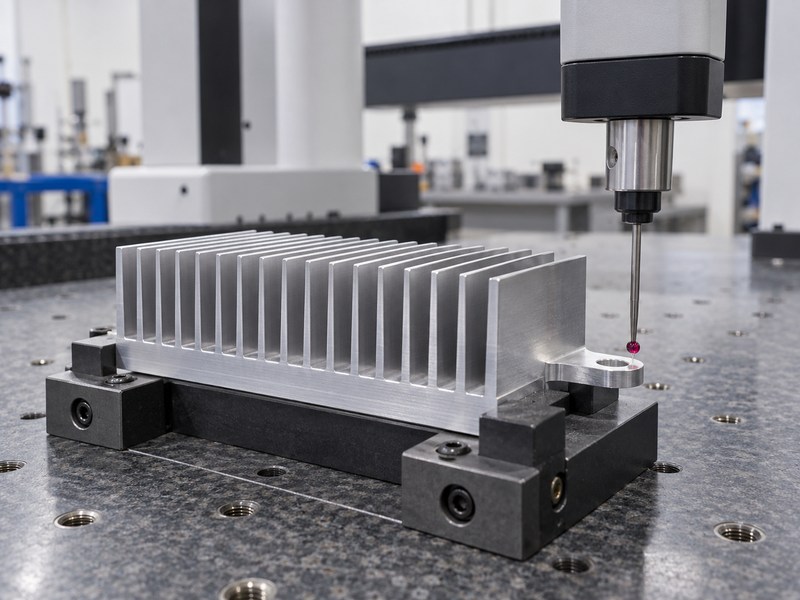
Request tolerances for a wire EDM aluminum heat sink feature by feature, using functional datums and a defined inspection method. Wire EDM can produce fine profiles, but a machine’s advertised accuracy does not establish the capability of your complete thin-fin component. Material condition, flushing, fixture design, and finishing passes affect the delivered geometry.
Which surfaces control assembly?
Separate profile accuracy from contact quality. Fin pitch, slot width, base flatness, mounting-hole position, and surface roughness describe different requirements. A smooth EDM-cut wall does not establish a flat device-contact face. That face may require a separate machining operation followed by inspection in the agreed support condition.
- Identify the thermal contact datum.
- State which dimensions apply after coating.
- Define sampling and measurement access.
How should you treat the cut surface?
EDM is a thermal removal process, so surface condition deserves review where fatigue, corrosion, or later finishing creates a concern. Ask whether skim passes or further treatment are required. Avoid assigning a universal recast-layer thickness or promising a roughness value without an agreed process and inspection basis.
| Requirement | Specify separately | Acceptance evidence |
|---|---|---|
| Fin geometry | Pitch and width | Dimensional report |
| Device interface | Flatness and roughness | Defined measurement |
| Finished fit | Coated dimensions | Post-finish inspection |
Key takeaway: Tighten dimensions that control function and verify how they will be measured.
7. Does a wire EDM aluminum heat sink need anodizing?
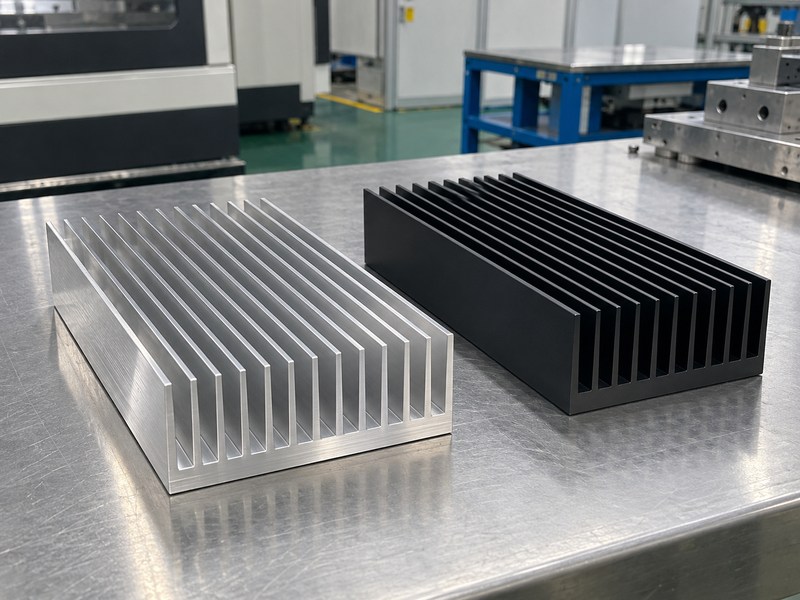
Anodizing changes the surface condition of a wire EDM aluminum heat sink, so specify it alongside contact, fit, and grounding requirements. An anodized surface can increase radiative heat transfer compared with bare aluminum. The resulting temperature benefit depends on geometry and operating conditions; black appearance alone does not establish a cooling rating.
Which areas need masking?
Mark the interfaces before finishing. Oxide on a device-contact surface adds a layer in the conduction path. Grounding lands and electrical bonding points also require explicit review. Coating growth can change tight fits and narrow gaps, so define masked areas and the dimensions that must be accepted after finishing.
- Identify contact lands and grounding points.
- Specify coating requirements without relying on color alone.
- Inspect critical features after treatment.
Should you test the finished part?
Yes. Validate the coating, thermal interface material, and mounting pressure used in production. A bare sample with one interface cannot qualify a coated assembly with another. Also, avoid treating anodizing as a certified electrical insulation system without the required dielectric specification and verification.
| Surface | Review question | Drawing action |
|---|---|---|
| Exposed fins | Finish purpose? | State coating |
| Contact land | Thermal path affected? | Define masking |
| Grounding land | Electrical bond needed? | Define acceptance |
Key takeaway: Approve the finished interface, including any masked areas.
8. How should you test thermal performance?
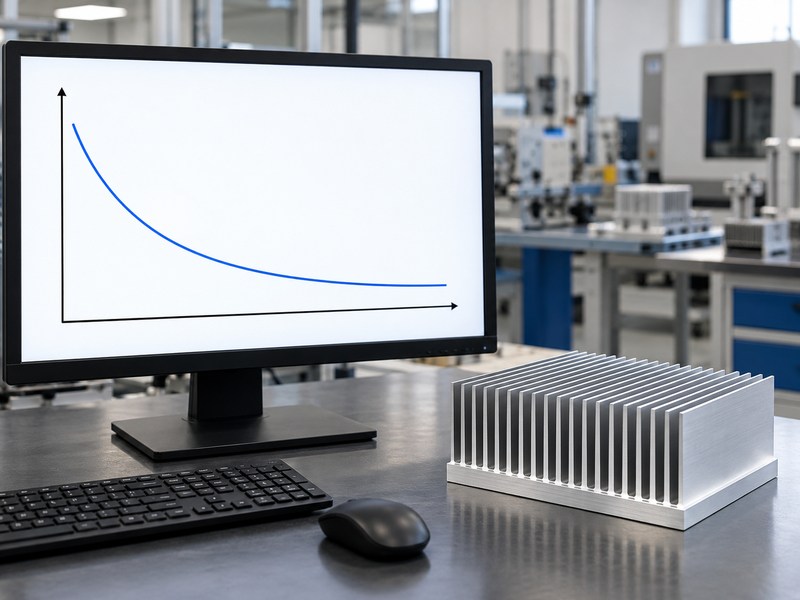
Test a wire EDM aluminum heat sink with the intended source footprint, effective thermal load, inlet temperature, mounting method, and installed airflow. Record temperatures after the agreed steady-state criterion is met. A lower heat input, a different source footprint, or a different duct can produce a result that does not describe your equipment.
What does a useful thermal budget look like?
Define the temperature reference. For an illustrative 100 W thermal load, a maximum base temperature of 75°C and inlet air at 35°C permit a base-to-inlet resistance of 0.40 K/W. This calculation allocates 40 K of temperature rise to that path. It does not include device junction-to-case resistance or any interface rise above the base.
- Measure inlet air away from heated exhaust.
- Record sensor locations and effective heater power.
- Keep the interface material and clamp load consistent.
When should you review liquid cooling?
If the allowable temperature rise cannot be met within the available airflow, noise, and envelope, compare a cold plate using defined coolant conditions. That review must include inlet coolant temperature, flow, pressure drop, material compatibility, and leak acceptance. An air-cooled resistance and a liquid-cooled resistance need clearly stated reference conditions before comparison.
| Illustrative input | Value | Meaning |
|---|---|---|
| Thermal load | 100 W | Effective heat input |
| Base minus inlet | 40 K | Allowed temperature rise |
| Base-to-inlet target | 0.40 K/W | 40 K divided by 100 W |
Key takeaway: Accept the thermal result with its boundary conditions attached.
9. What should a wire EDM aluminum heat sink RFQ include?
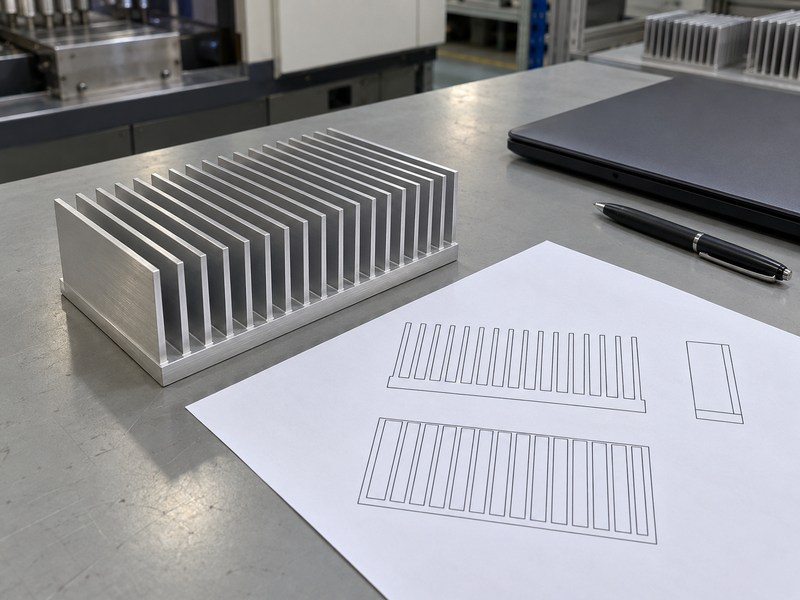
An RFQ for a wire EDM aluminum heat sink should connect the drawing, operating conditions, inspection plan, and purchasing quantity. Include the geometry that needs wire cutting and the features that require other operations. Ask suppliers to identify exceptions before they return a quotation, particularly when fin geometry or coating changes are proposed.
What should the technical package contain?
Make each acceptance point measurable. Supply a STEP model and dimensioned drawing with matching revisions. Add heat-source size, thermal load, maximum base temperature, inlet conditions, and the available installation envelope. Separate sample quantity from forecast production demand so the manufacturing route can be compared across both stages.
- Define material, temper, finish, and masking.
- Identify critical datums and post-finish dimensions.
- Request dimensional and thermal evidence where required.
What needs agreement before sample approval?
Confirm the final operation sequence, inspection scope, packaging, and any capability limits. The supplier should state which drawing requirements remain open. If you want morton to compare manufacturing routes for your assembly, contact us with the drawing, heat load, airflow constraints, and expected quantities.
| RFQ item | Include | Resolve before release |
|---|---|---|
| Geometry | Model and drawing | Revision agreement |
| Performance | Thermal boundaries | Test acceptance |
| Supply | Quantities and records | Quote scope |
Key takeaway: Approve a defined component and verification plan before repeat production.
10. What else should buyers ask?
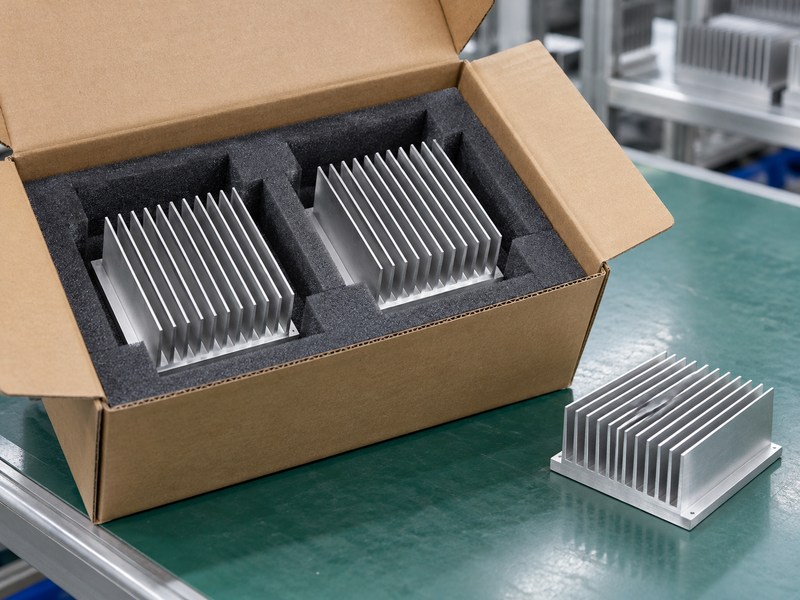
Buyers should settle access, thermal validation, and supplier capability questions before ordering a wire EDM aluminum heat sink. These checks help distinguish a feasible profile from an approved cooling component.
Which questions close the remaining gaps?
Q1: Can I wire-cut aluminum fins without cutting the base?
Yes, if the part orientation and through-cut path permit it. The comb-shaped profile can retain its base while the wire passes through the component’s depth. Ask the supplier to show that path and the workholding arrangement.
Q2: What’s the best fin spacing for my enclosure?
There is no universal spacing. Compare fin area, channel resistance, bypass, and the fan operating point under your installed conditions. For passive cooling, include orientation and buoyant airflow in the review.
Q3: How do I know if a narrow slot is practical?
Request a geometry-specific capability review. Wire diameter, discharge gap, part depth, flushing, finishing passes, and inspection access all matter. A nominal wire size is insufficient evidence for the finished slot.
Q4: Can I use a black anodized sample as proof of better cooling?
No. Color alone cannot establish thermal performance. Compare finished assemblies with the same heat source, inlet conditions, interface material, mounting pressure, and air path.
Q5: Does morton confirm wire EDM capability for every inquiry?
Capability needs project review. Share the complete drawing and operating requirements so the team can compare machining and other manufacturing routes. Confirm the proposed supplier, process scope, and acceptance evidence in the quotation.